
Interviewed by Hayden Fulton on November 18th, 2024
Natalie B. Aviles is an Assistant Professor of Sociology at the University of Virginia. She is the author of An Ungovernable Foe: Science and Policy Innovation in the U.S. National Cancer Institute (Columbia University Press 2024).
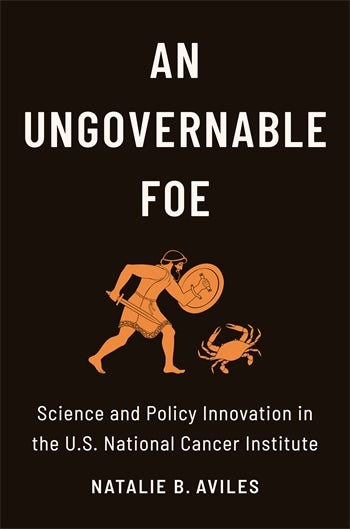
Hayden: Throughout the book, you make a strong mandate on why STS scholars and sociologists more broadly should be studying federal bureaucracies, including the NCI. To start off, I was wondering if you could say a bit about how you came to this case?
Natalie: I came to this case originally out of what I think is the more common impulse for people who become interested in STS, which is that I was fascinated by virology. There was a point when I was an undergraduate around the time that the HPV vaccine first hit the market and I found out for the first time that there were viruses that cause cancer, and nobody had really talked about this. I was interested initially in the gender dimensions of how this relatively ubiquitous virus was being addressed as a concern of women specifically. I wanted to understand why that was happening for this specific cancer virus, and not for other viruses and especially oncogenic viruses (the viruses that cause cancer). I followed this sort of impulse through my undergraduate years and in the first few years of graduate school (Aviles 2015). It was when I was really diving into the topic that I realized there was a pretty consistent presence of the National Cancer Institute in most of the viral cancer research that I was studying, so I thought that was very interesting and worth pretty sustained attention.
Originally, I started studying the National Cancer Institute just as an organization, using an organizational sociology lens to try to understand how do certain processes work when we think about them as being contained within the spatial and temporal dimensions of a formal organization? Which had not been the subject of a lot of work in STS. When I wrote my dissertation, it was really with the more general organizational sociology insights in mind, and I’m embarrassed to say that it took me a really long time to actually recognize the importance of the fact that this is a federal agencyspecifically. That’s a very distinctive kind of organization and it has really interesting theoretical implications for how we think about why people do science in a particular way rather than another way. To use the language of the economists who tend to be the ones that study federal agencies (alongside political scientists), there’s just a very different set of incentives for people who go into federal government. They’re choosing to forego higher incomes that they could have in academia and industry, they’re really choosing to do research that has a public mission. It was really after I had written my dissertation and was turning it into a book that I realized the political story–the story of the NCI as a federal agency–was actually the most interesting thing about this series of case studies that I had started exploring a really long time before that.
What made it so interesting is that these specific experimental decisions that people were making when it came to how to study cancer viruses–which cancer viruses to study and the new directions to take research–were kind of unexpected given the basic mandate of studying viruses and cancers. All of these things were shaped by the NCI’s mission as one where its employees were subject to this dual mandate to do good science and to make it health relevant. And so, the story of the federal agency and the story of the science are incredibly intertwined, and I think that was very rich and fascinating from an STS perspective. It definitely took me a long time to sort of admit that I needed to be a political sociologist about this, but as soon as I sort of jumped in with both feet on that, I found it to be incredibly enriching. Theoretically NCI is the gift that keeps on giving; it really highlights the importance of the work that we can do in STS. There is a long history of work in STS that’s about science and the state, but when we think about the state, we tend to think about it in a very legislative lens or sometimes the courts. But I really think federal agency policymaking is one of those things that sounds really boring, but is actually incredibly interesting for people who want to understand the relationship between how we organize science and how we do science when the stakes are really high.
Hayden: Absolutely. The book focuses on the place of individuals you refer to as “scientist- bureaucrats” or “researchers who obtain administrative positions in the institute [NCI] and thus occupy organizational rules that tack back and forth between the bench and the boardroom” (pg. 9). Could you speak on how you conceptualize these folks and the work that they’re doing?
Natalie: Scientist-bureaucrats are, like you said, essentially working scientists who have active research agendas who, usually because of their success in managing science and doing high profile science, attain leadership positions in the National Cancer Institute. These are intramural scientists, they’re government employees and they work for this agency, where they’re allowed to do this science, but the agency is also playing a very important role in governing cancer research for the entire country. As they ascend the administrative hierarchy, they come to take on more and more bureaucratic tasks that are vital to the functioning of the governance apparatus. And there’s a lot of very small-scale policy decisions that get made, and then there are also more large scale policy conversations that they become involved in when they rise to positions of particular prominence.
I focus a lot on the directors of the NCI because these are folks who have an opportunity to really steer the conversation for cancer research in the entire country. One of the really important things that scientist-bureaucrats do is represent the agency to what I call [drawing on principal-agent theory] its “political principals”, so Congress, who basically have to authorize the appropriations for the Institute that pay for its functions on a year to year basis. They have to testify in front of Congress, they have to create these budget documents, they have to defend what the Institute is doing scientifically in-house as well as the direction of research for grants that get distributed, which is mostly what the NCI does. And then they also have these “scientific principals,” and these are expert scientists who don’t work for the federal government but who are appointed by the President to various boards like the National Cancer Advisory Board or the President’s Cancer Panel, essentially in an oversight function. They’re sort of meant to be an external quality check on the science that’s getting funded and the policy agendas that are essentially choosing how billions of dollars every year are going to be invested strategically in a lot of cases.
This is a really interesting hybrid role that [scientist-bureaucrats] take on, where they continue to be scientists, but they’re also making these really important policy decisions for the agency. And the thing that I was able to show throughout the book is that the way that they need to answer to these principals, the way that they need to answer to Congress (who are meant to really represent the interests of the people) and the way that they answer to their scientific principals on these advisory boards (which are essentially meant to represent the interests of scientists), it doesn’t just sort of shape the policy direction that the agency takes, it also shapes the direction of these scientist-bureaucrats’ scientific projects as well. There is this really interesting dynamic where we’re actually seeing their science changing as they’re doing policy to become more and more policy relevant as they become involved in policy. It’s this very interesting story that’s not just about policy outcomes which are interesting in themselves, but it’s also about how organizations shape science and the specific dynamics that happen when people have these hybrid roles. So obviously not everybody in the NCI is in leadership and becomes a scientist-bureaucrat, but in these specific instances where we can actually observe people’s trajectories over a very long period of time, we can kind of see them change in really interesting ways as they become involved in these organizations in a different way than they used to be, and I think that’s a really important takeaway for STS and for sociology of science.
Hayden: In the book you describe yourself as part of the pragmatist tradition, and specifically think about scientific innovation through the “environed social learning” framework. Could you talk a little bit more about this model and how you see it as impacting your work?
Natalie: I consider myself not just a sociologist of science, but very centrally, a theorist as well. I situate myself in this pragmatist theoretical legacy in sociology and my [bigger] project, which the book contributes to, is trying to bring pragmatist sociology into line with developments in contemporary pragmatist philosophy. I think sociologists have really been milking classical pragmatism for a very long time. Some of our famous insights, even in sociology of science, have been based in the initial impulses of classical pragmatists like Dewey and Mead, and that has paid a lot of dividends for sociology generally in terms of theory, but also for STS specifically. I think our legacy of pragmatism is really rich and excellent, and I want to continue to bring this into the philosophical present. In the book I talk mostly about Joseph Rouse, who was inspired by pragmatist philosopher Robert Brandom. These two theorists are really taking an insight from classical pragmatism about the developmental nature of social learning between organisms and their environments and trying to make them a little bit more genuinely social. I think the focus of classical pragmatism is “what do individual minds do in their environments, in these situations that sort of present themselves to experience?” and “what does it mean for action to respond to those environments in particular ways and [for actors] to formulate provisional ends to pursue?” I think this is a great philosophical project, but it also takes a very individualistic perspective. What Brandon and Rouse have done is try to make the collaborative social dimension of meaning-making much more central to the pragmatist project.
When I use Rouse to talk about the emergence of issues and stakes in this book, it’s really about the fact that when governance is happening, it’s a conversation. And so, these scientist-bureaucrats are responding to their political and scientific principals because they have these commitments that are embedded in the dual mission of the agency to fund the best science and to make it health relevant. They have to justify their ongoing work before these people who essentially allow their work to continue, and they do this in earnest. They do this in ways that are meaningfully tied to what they’re doing in the laboratory and to what they believe the right policy decisions actually are. Meaning-making is very central to this, it’s central to the way that people argue what is going on in a particular situation, what’s “at issue” in Rouse’s formulation. And then, what are the consequences of doing certain things about that rather than others? And this is the formulation of the stakes of not just their policy decisions, but also their science. What these contemporary pragmatist thinkers like Brandon and Rouse allow us to do is really bring the focus back to a normative dimension of science, to really ask, what does it mean for people to continue their activities towards certain meaningful ends or to have to transform their environments so that they can do activities differently in the future?
Looking at decision making in the NCI, both scientific decision making and policy decision making over 70 years, you’re actually able to see how there are these really crucial instances where people try to collaboratively define what is going on and what are we going to do about this. Defining those issues and stakes is really consequential for how people do science and for how people govern science. This is a theoretical inheritance from these contemporary pragmatist philosophers that can really enhance this long legacy of excellent pragmatist work in sociology of science. I think this is a distinctly sociological take as well. Meaning really matters. It’s not just about incentives, things matter to people and here are these theorists that can really help us understand how this happens in particular organized social settings. I hope that people who are more interested in formal organizations, particularly in federal agencies, are able come away from the theoretical framing of this book with some new insights and some new ideas about how to analyze behavior.
Hayden: The next question focuses on your writing and analysis process. Across the 70 years of history you analyze in the book we meet a wide variety of really fascinating people, Mary Woodard Lasker, Vincent DeVita, James Watson, how did you go about balancing bringing in these really interesting biographical insights, with keeping the overall story about the organization itself?
Natalie: I think one of the really fascinating insights about organizations that has actually created this sort of perennial theoretical problem is, what does it mean to have an organization as something that persists beyond the individuals that constitute this social order? That’s a classic problem, not just in organizational sociology, but in sociology generally. This is just a perennial problem in our field, and I think in organizational sociology’s more adventurous theoretical approaches people have really tried to take on this question in earnest. I really appreciate a lot of the creative theoretical work that’s gone into trying to show how individuals really matter, but how social order persists in one way or another even when certain very central figures depart the organization.
The conceptual tool that I used here is of social learning, the idea that learning is not just an individual attribute. It’s very significant in this story and in any story about how practices change over time, because learning transforms the environment for action. It’s not just something that’s contained in people’s heads, it’s something that people will alter their material circumstances in order to continue their conduct, having learned from the past and trying to realize a future where things are different. There’s a lot that goes into altering the environment, and in bureaucracies, there is a physical dimension. There’s a material dimension to conduct, and science makes that really obvious in ways that paper bureaucracies don’t. We benefit a lot from thinking about how social learning actually alters environments by looking at science because it’s more legible theoretically. [Science] is so much more material in its practices, but there are also rules that change. There are practices around funding that change. There are relationships between different units in the organization and different oversight bodies. People come in and they make big differences because they are sort of the source of a lot of the meaning-making, the thing that’s central to transforming the environment. But once they’ve made these transformations, these transformations are the new situations that people have to conduct themselves in. And so, there are these really interesting [historical] dynamics where the organization swings really far in one direction, towards doing this very outcome oriented/mission driven work and then there are these reactions toward what that environment looks like and they swing back towards what they call basic research. There are fascinating circumstances where the actions of individuals in the past create the circumstances for conduct in the present and set the table for what’s going to happen in the future. People have to respond to an environment that’s been changed by folks who came before them.
It is a really difficult theoretical balance to strike, I hope that I did a good job in the book doing it. But in terms of writing a book that follows really fascinating characters over a 70-year period, you also want to sort of inhabit the institution, to use the organizational sociologists’ terminology [of “inhabited institutions”] that I personally prefer. Peopling the bureaucracy is a big project here. Bureaucracies are not stale and boring all of the time, people are doing things in them that are really interesting. Stories are very evocative and very powerful when it comes to policy, and we see that illustrated many, many times throughout. Policy is not just rational means-ends calculation. It’s people telling really meaningful stories and persuading other people that this is the way things should be done. I don’t think it’s just making the book more readable and interesting, it is actually what people are doing that makes their work relevant and interesting. I’m really just sort of communicating to readers that this is what life was like on the ground in this organization by showing them a little bit of experimentation and a little bit of the intense negotiations sometimes that happen around how we should do policy one way rather than another. Hopefully reading the book is something that persuades people that formal organizations aren’t super boring, they’re actually very interesting and they sort of entrap people spatially and temporally in ways that we don’t have to think about in very stale traditional perspectives, we can actually be very creative in thinking about, you know, what does this mean for how people have to act? And what does this mean for their science? I hope that it’s also a mark towards trying to get more people [in STS] interested in thinking about formal organizations and thinking about science bureaucracies specifically.
Hayden: My next question is similarly thinking about how bureaucracies impact folks over time. I would argue a lot of the best sociology has a like bit of irony, and I think that this book definitely hits that mark. A wonderful example is the argument you present on the Special Virus Cancer Program and how in that we can see almost success in failure. I was wondering if you would be able to talk a little bit about that case and what it has to say about success/failure and public accountability?
Natalie: Yes, absolutely. You know, success and failure are hard to call in science because today’s failure can be the basis of tomorrow’s success. The Virus Cancer Program is an amazing, like you said, very ironic illustration of how this plays out. Success and failure have to be argued into reality in really interesting ways. Part of the story here is that there was this initial assumption in the Virus Cancer Program about viruses being the sort of initiating factor in [triggering] many human cancers, and so a lot of money was poured into trying to do what was essentially, based on later reconstructions, the first Moonshot for cancer. We have one under [Beau] Biden’s name now, but there was one in the 60s and 70s as well. The idea was that if you poured enough money into this sort of defense and aerospace-inspired application of systems theory techniques that you would come out of it having essentially a universal cancer vaccine. And of course, the basic assumptions for this ended up being flipped on their head, and the people who did that [Harold Varmus and J. Michael Bishop], who were mostly funded by NCI contracts, ended up winning a Nobel Prize for their research. [NCI’s] idea was that it was virus DNA that caused most cancers, [and Varmus and Bishop] essentially reversed it in order to illustrate that it was actually cellular DNA that was being either activated or shut off that was responsible for causing cancer. We went from the viral oncogene hypothesis, which was proposed by these NCI scientists in the Virus Cancer Program, to the cellular oncogene hypothesis. But all this research is related. It’s all sort of in conversation with one another as people are trying to make sense of what is manifesting in their experiments, especially as it relates to this overarching goal of the Virus Cancer Program, which is to try to prevent human cancers through some vaccine-oriented [technology].
The Virus Cancer Program was essentially declared this catastrophic failure, this total waste of money. [But what was] happening was by the mid-1960s, most of the research that went into the Virus Cancer Program went into research on retroviruses, and suddenly, when the HIV/AIDS epidemic struck in the early 1980s, and all of this infrastructure and all of these resources that were specifically tailored toward retroviral research, suddenly made the National Cancer Institute able to respond to this new outbreak very, very quickly. There was spectacular irony in the fact that this failure ended up being the basis for the NCI’s successful identification of HIV as a viral culprit of AIDS, along with researchers at the Pasteur Institute, and then its development of the first effective treatment against HIV/AIDS, the nucleoside analogs. [As Steven Epstein has also pointed out in Impure Science,] you had this incredible concentration of expertise as well as resources and infrastructure that allowed the federal government to respond very quickly and very effectively from a surprising quarter because it was actually these cancer researchers that had invested in retroviral research and thus were able to respond to a very different kind of viral threat in the 1980s.
That’s a beautiful irony that we love to see, right? I think it’s one of those very powerful illustrations where as soon as it became very clear that it was a retroviral candidate that was responsible for HIV/ AIDS, and also that a lot of the tools that were developed around the attempt to identify these human cancer viruses had become some of the sources of the early biotech industry [as Joan Fujimura has written about], the National Cancer Institute made a concerted effort to rehabilitate its own image. To basically say, all this money that people thought in the 70s was totally wasted ended up doing big things for the growth of this economic sector that was new and also for the government’s ability to respond very effectively to this really terrifying epidemic. It was very difficult for the NCI to defend against accusations that it had failed back in the 70s, but by the time the 80s rolled around, there was a concerted PR effort essentially to say that without these investments we wouldn’t have been able to accomplish these things. Success and failure are definitely negotiated, they are achievements. They can be argued and they are very creatively argued throughout this book by people in the NCI.
Hayden: Throughout the book, you do a really wonderful job of weaving together interdisciplinary scholarship from folks that don’t always talk to each other well, so I was wondering if you’d want to expand at all on what strengths you see yourself bringing to this project specifically as a sociologist?
Natalie: I learned a lot from political science and economics because when it became very obvious to me that it mattered that the NCI was a federal agency, what I found is that when it comes to sociology of science, there just isn’t enough on the specific dynamics of accountability and the relationships between [mission-oriented federal science agencies] and their overseers. I really felt like I had to go read pretty widely in economics and political science to try to understand what it meant to be beholden to external advisors as a scientist. I really felt like the strengths of sociology were in analyzing what was happening in the laboratory, but that I needed a little bit more beyond our traditional STS interdisciplinarity to try to tell the full story. I really value being interdisciplinary in the broadest possible sense. I learned so much from economics and political science, but I also took a lot of these insights and recognized that sociology needs to modify them in order to be able to account for all of the empirical richness of these normative motivations that really seem empirically to be driving people to make certain decisions rather than others. There was this point where political science and economics were great for offering this perspective on principal agent theory but it very quickly ran up against these limitations about incentives and how they structure action. There’s not a lot of room for norms there. There’s not a lot of room for non-monetary incentives. People have to get very creative in trying to understand how people respond to a world when it’s not just about maximizing their own utility, especially when it comes to making money because people in the NCI aren’t making much money! They’re specifically there because they care about something other than money. At that point, I really needed to think more sociologically, and even philosophically, about what’s driving the patterns that we’re actually observing in these cases.
I think the spirit of STS is to be interdisciplinary and I really have taken that to heart in my work, and definitely in the book. One of the things that I’ve heard from policymakers who are in the White House, who are in Congress, is that they get a lot of insights from the more quantitative arm of economics and political science and even sociology, but often the most persuasive things are the stories. This was a very surprising thing to me to hear from people in other arms of the government and the people who are in the White House and in Congress, and so I think we as sociologists should really take that to heart. We actually do have tools that are very valuable to policy making. We are the ones who can tell these stories and then make them more generally applicable and therefore very informative to policy makers. I have found that is one really special thing that our work can do to really influence the direction of policy going forward.
Hayden: And my next question is also thinking about the audience and impact of this book, specifically, how do you hope this work is taken up by folks working in cancer research?
Natalie: Yeah, it’s such a great question because I feel like there are a lot of things people can take away. A lot of researchers in the extramural community sort of see the NCI primarily as a grant issuing institution, and in fact, when you apply for NIH grants they sort of just go to the study sections that are staffed by the people who have the most relevant expertise for whatever the research is that you’re proposing. A lot of people see the grants and they understand that this is taxpayer money and that it’s going through the NIH, but they don’t necessarily appreciate how involved NIH scientists are in actually setting the policy agenda. Actually seeing how much goes into trying to shape the direction of policy is something that’s very important for anyone who is in the [academic] research community. Particularly getting a little bit more expansive sense of the political economy of research and development, and the incredibly central role that the federal government has played in laying the infrastructure for a lot of the developments that have been made in the last century and for continuing to sponsor a lot of research that, for example, private industry just doesn’t do. A lot of the burden of this has shifted to academic scientists, so appreciating that they play a role in a larger political economy of research and development, which I think a lot of people intuitively do, but maybe they don’t understand the scale of things.
I think it is very helpful in a more applied sense that we potentially have a lot to lose by scaling back federal involvement in [biomedical] research and development, and so this is a time when people may want to consider how involved they can get in advocating for the NIH, which is a large source of funding, rather than fighting over grants and thinking about how much money there is in the pot and worrying about how much that money has been shrinking. This is really a time to orient oneself toward the political principals that are really authorizing these budgets and advocate on behalf of federal investment in cancer research, because that’s where so much of the breakthroughs actually happen. It’s not just the private sector. Having a sense of the political economy of research and development and then really trying to play a more active role in steering policy making in the centers of power like Congress, where these decisions actually happen. I hope that [academic] scientists can get a sense of the stakes of losing these federal agencies to mismanagement or even just [fiscal] retrenchment.
Hayden: Thinking more explicitly, we’re having this conversation on November 18th 2024, obviously these are going to be thoughts in process as we just learned the results of the 2024 election. For researchers more broadly how do you see the challenges that the NCI might face with the new administration, and what are your thoughts on what our responses should be?
Natalie: Even at the time I was writing this book, which was during the pandemic, there had been a very clear shift in the way that people think about the federal government. I even mention it towards the end of the book. The NCI and the NIH in general have [historically] enjoyed pretty broad bipartisan support. It’s been pretty much understood across the aisle that federal investment in biomedicine is something that pays dividends economically and politically. It’s been a valued source of investment of taxpayer money, but I think the game is changing. It was very obvious even at the time I was finishing this book that the game was changing. I talked a little bit about how there was this growing sort of partisan resentment of the NIH. This came forward in a very pronounced fashion around criticisms of Anthony Fauci specifically, who was the head of the National Institute of Allergy and Infectious Diseases at the time, regarding the federal government and its response to the COVID-19 pandemic.
I think there were already signs that partisanship in general was changing the game when it came to the political principals in Congress and that we needed to be very attentive to this because new things were happening that I didn’t observe much over this 70 year period, which is that people were really threatening to slash the budget of the NIH. In the first Trump presidency, this was a proposition that was put on the table and very quickly knocked aside by very strong bipartisan support, but I think the composition of Congress is changing in response to this radical rightward shift and I think that this is jeopardizing the federal investment in research in general. We’re looking at a united Republican government and we’re looking at specific initiatives emanating from the Trump administration specifically, but also tied to these long-running ideas that the federal government needs to be changed, the federal workforce needs to be [reconstituted]. There was this initiative that Trump passed as an executive order called Schedule F at the end of his first presidency. Schedule F was this idea that there were a lot of civil service appointments that should be converted to presidential appointments. There are reasons why this is very bad, there has been independent political analysis of this. Rachel Potter, who’s a political scientist, has demonstrated something that comes through in great detail in my analysis of Andrew von Eschenbach’s presidential appointment as the director of the National Cancer Institute in the George W. Bush administration, who had not been promoted from within the civil service but from outside. The insights that political scientists can share are that political appointees are far less efficient, they don’t really know how to govern in the same way that civil servants do. Civil servants have very valuable expertise, and in the case of an expert science agency like the NCI, that expertise is hybrid, it’s expertise in the science, which is very necessary to make good policy decisions, to make good estimates about what the future consequences of policies can be, and then they also have experience in [administration]. They have experience in making policies and understanding who their stakeholders are and being able to make compromises that are effective and long-term sustainable for the future. Presidential appointees usually don’t have this knowledge, and so they create incredible inefficiencies in the federal government when they replace these civil servants who are also very invested in agency missions.
I demonstrate this in the book, in the case of von Eschenbach. What I’ve shown in the book is something that makes me very concerned for proposals to really scale back federal agencies, including within Health and Human Services, which is what the NIH is part of. I think what we have is a potential future where this really valuable capacity that has made the US federal government a source of [biomedical] innovation, not just from government scientists, but from everyone who benefits from NIH funding, we are potentially going to see a future where our capacity for innovation is stripped for purely political reasons. I think this is very short-sighted and I hope that this book can at least persuade people why the federal government is a very valuable source of expertise, and why civil servants particularly should continue to play the premier role in determining the policies that are going to govern the nation’s science going forward. Presidential appointees are not just inefficient, they also are not necessarily attuned to these missions that really foreground public good. I hope that this book provides people with some insights that they can use to make better decisions in a future that is going to potentially look a lot like one of the least effective periods in NCI history and the entire book. And it’s not just me, a lot of political scientists who study presidential appointees have said very similar things. What I think this book illustrates is why that’s the case. They just don’t have the kind of expertise where they can make effective decisions about what research is going to look like in the future, [but expert] civil servants do have that expertise. I think that this book can really speak to the potential negative impacts of transforming the civil service in line with some of these proposals that have been issued from the new administration.
Hayden: As a follow up question, do you have any examples from von Eschenbach’s time as director of ways that folks at the NCI were pushing back against his actions and/or ways that their actions were constrained and unable to make an impact?
Natalie: This is such an important section of the book because a lot of people could read a lot of the book and say this is really just a story of leadership and not really the story of the entire agency… but it is a story of the whole agency working together. I think having a really ineffective director in the form of von Eschenbach is a great illustration of how civil servants can be a check on a lot of the less constructive impulses of both their political principals in Congress as well as presidential appointees. This is a really interesting situation where it matters that civil servants in the NCI are working scientists, that they care about the science and not just about the agency justifying its own existence by any means necessary. When von Eschenbach famously proposed that they were going to eliminate suffering and death due to cancer by 2015, and he proposed this in 2003, this was so scientifically implausible to people within the agency as well as their principals on the National Cancer Advisory Board and the [Board of Scientific Advisors], people really tried to push back against this in strategic ways. We see in the political science literature that when civil servants are confronted with policies that seem ineffective or even destructive to the agency’s long-term existence, they will try to continue doing their work in a way that pushes back, even if they can’t explicitly rebel against these forces.
One of the things that really preserved the NCI, not unscathed, for the future was the fact that this is an agency that has to be beholden to plausible interpretations of what can happen in the future in science. This is why this is an STS story and not just a political story, because people were looking at the science and the substance of the science and arguing that these political goals cannot be realized with the state of the science the way that it is. You have to satisfy your scientific principals and not just the principals in Congress who might want to be persuaded by this idea that if we give this federal agency lots of money, they’ll cure cancer in a little over 10 years. Scientists really pushed back against the plausibility of this narrative. In this way they were able to sort of resist the takeover not just of someone who proposed some policy initiatives that were not sustainable long-term but also someone who really wanted to privatize a lot of the agency’s functions. They were a really interesting check against a lot of these impulses towards privatization that von Eschenbach was the representation of in the NCI that we saw throughout the George W. Bush administration. Interestingly, the NCI was able to stave off a lot of these neoliberalizing impulses, in part because agency scientists really thought that this conception of the public good was part of their work and their mission, and what made their work meaningful. I think that’s a really powerful story about how bureaucracies can resist political initiatives.
Hayden: Is there anything else you would like to highlight that you hope readers take away from your book?
Natalie: A lot of what I do in this book is sort of dispel some common misconceptions about vaccine development. I would want to highlight that a lot of people have really thought about vaccine research and development as being mostly a private enterprise, and I’m able to show in this book that actually the federal government plays an outsized role, because vaccines are actually not very profitable! They are very public goods compared to a lot of other biomedical technologies. There’s some work I do in the book that is an attempt to really demystify vaccine development, especially around the HPV vaccines, which were a source of a lot of anti-vaccine disinformation when they came out. That’s such a fascinating story that I’m not really able to get into in the book. The public reception of these vaccines was really overshadowed in part because they were the first new vaccines to emerge after the Wakefield scandal about autism and vaccines. A lot of the disinformation that had been generated around MMR was sort of transposed onto the HPV vaccine. That was just such a fascinating period of vaccine history, and I think what the book really does is show how that vaccine was actually developed, and I think it’s really important for people to understand that it wasn’t actually a profit motive. It wasn’t just Big Pharma. It was largely the federal government (Aviles 2018). It’s a very similar story for the COVID-19 vaccine as well, that mRNA technology came out of a lot of NIH intramural science. I think there are just some misconceptions about vaccine research and development that the book can also speak to.
Hayden: Yeah. I feel like the case of AZT and how the NCI learned and acted differently in the future also speaks to the impact of the profit motive.
Natalie: Yeah, and the fact that actually the federal government is really trying in its own ways to conceptualize what it means to operate in terms of the public good and to protect taxpayer interests. They’re not that effective at it because they’ve really got an uphill battle, but there have been concerted efforts to try to make sure that taxpayer money is spent in a way that they think reflects the public interest in these technologies. I think that’s something that’s really worth highlighting as well, that they actually are doing things. But they’re pretty small fish in this pond so their efforts are often stymied by the broader political economy of vaccine research and development.
Hayden: Thank you so much for your work and for taking the time to speak with me today. The last question I have for you is what are you working on now? Is there anything we should be looking out for?
Natalie: Yeah, I’ve got a couple of different things that I’m working on. One is a continuation of my interest in cancer research. Something really important happened at the end of my period that I talked a little bit about in the book, which is the passage of the 2016 Beau Biden Cancer Moonshot. This is sort of the latest big cancer policy initiative. There was something that happened when the Moonshot was renewed in 2022, which is that it was relocated from within the NIH and into the White House Office of Science and Technology Policy. I’m really interested in what happens to policies when they’re taken away from federal agencies and relocated elsewhere in the executive branch. I’m comparing the NCI’s way of doing policy with the White House’s way of doing policy. There’s also an international comparative dimension there, I’ve been comparing the Moonshot with some initiatives in Finland. I’m branching out a little bit to more global comparative science policy perspectives. Then there’s another branch of my research which really has to do with expert federal agencies. I want to look at other federal [health] agencies too, so my next project is on how the Centers for Medicare and Medicaid Services built administrative capacity to prosecute fraud and the relationship between this and initiatives to develop electronic health records infrastructure. I think there’s an amazing story there, and it’s a very different federal agency. I’ve been working on this project and I’m very excited about it, because I want to continue being able to offer these very rich case studies of federal agencies that are relevant to people in STS while still really pursuing my interest in cancer research specifically. I’m bifurcating a little bit, but I’m still very much involved in in both of these things at the same time.
 Welcome to the official website of the Science, Knowledge, and Technology (SKAT) Section
Leave a comment