
Interviewed by Molly Clark-Barol on December 2, 2024
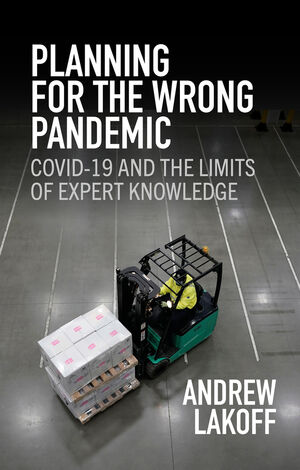
Andrew Lakoff is Professor of Sociology and Anthropology at the University of Southern California. He is the author of Planning for the Wrong Pandemic: Covid-19 and the Limits of Expert Knowledge (Polity 2024).
Molly: Thanks so much for chatting, Andy. I just wanted to let you know how much I really appreciated this book. To start with, I think it’s so accessibly written. It feels like the kind of book that I would give to someone like my parents– engaged, intelligent, “lay” people. It really captures the relevance of these STS theories to something we all just lived through. And, I really appreciated how deftly you approached what is quite political, may be quite emotional and fraught for people still.
Andy: Thank you.
Molly: Your book, Unprepared, published in 2017, was about “the invention of a new way of approaching an uncertain and potentially threatening future” in terms public health emergencies. And then you had been working with Stephen Collier on Government of Emergency, which was subsequently published in 2021, about “governmental practices designed to keep social and environmental life in operation in the aftermath of a future catastrophic event.” So, in the midst of that research agenda, at what point, living through the pandemic with the rest of us, did you decide to write this book?
Andy: I would say that experienced the early stages of the pandemic at two registers. One of these was how most people experienced it: as a family member and a person with a job, trying to understand how to navigate all of the uncertainty and to track what was unfolding for me and for my kids. But the other register was as someone who had, for some time, been thinking about how expert knowledge about the future is brought to bear in planning for possible threats such as pandemics. And so, I had this kind of surreal experience of watching unfold, in actuality, the virtual diagrams and schemas that the actors I’d been studying over the prior decade had created.
And then additionally, I was being asked– often by journalists, but also by other academics– to comment on what was happening as it was unfolding. So as early as February 2020, I began getting calls from journalists who had seen the title of my book, Unprepared, but had not actually read it. And so, they thought of me as somebody who had been a prescient analyst, who somehow knew in advance that we were unprepared for a future pandemic. I had to apologetically explain that this wasn’t really what I had meant by the title Unprepared. I had meant to describe the development of an ethos in which experts felt that their task was to warn the rest of us that we were unprepared. I was interested in how these experts generated a collective affect of a lack of preparedness, and then drew on that affect to assemble a set of devices that would be put into motion in the event of a future emergency. So, this, as you can imagine, was a complicated position to try to explain to reporters or to other interlocutors who really wanted to know what was going wrong [in early 2020], what should we be doing [with regard to Covid]. And I would typically say, well, that’s not actually the kind of expertise that I have. I’m an analyst of expert knowledge. And so, you should be talking to the government officials and the public health experts about what we should be doing. So, I was both an expert and a non-expert at the same time.
Molly: So, do you remember a point at which you decided, ‘I think I need to write this book’?
Andy: In the first few months of the pandemic, I became interested in controversies that were arising around some of the expert concepts and tools I had written about. In these controversies, each side took for granted the existence of those concepts and tools. And my interest was in asking, well, where did they come from? Rather than taking a stance in debates over social distancing measures or essential workers policy or vaccine development, I wanted to draw on my prior work to step back and ask, where did this way of thinking about the problem come from?
So, I wrote a few short pieces. I wrote one on the history of stockpiling, while there were a lot of controversies around the lack of available supplies for frontline workers early in the pandemic. I wrote a piece about essential workers policy, again, fairly early on when that was a major site of contestation. And gradually, as I accumulated these pieces, I started to realize that there was a pattern to the kinds of essays I was writing, that they were about these controversial, but at the same time, taken for granted concepts and tools for managing a pandemic. And that’s when I thought I should put them together as a short book. That was probably around 2022, something like that.
Molly: It is interesting that before writing this book, you were already having to delineate your expertise with people calling you up for takes during the pandemic. And then, subsequently, in the book, you were deft about going beyond what many people may be craving– the emotional catharsis of finding someone to blame. Your nuanced story of historical contingencies brings something unique to the conversation, but that involves resisting giving the people what they want, so to speak. How did you experience that? And then how do you think that affected the reception of the book, whether from popular reception, academic reviews, peers, family?
Andy: I think these questions are in the category of ‘how to characterize my critical position’. And the reticence to, as you say, “give the people what they want,” which is either a prescription (here’s what we should be doing) or a denunciation (here’s what people are doing wrong and here’s who’s to blame for this). And I think that critical analytic position, I attribute to the influence of my mentor, the anthropologist Paul Rabinow, who had a couple of ways of characterizing this. One, he called ‘adjacency,’ which is a position of engagement with contemporary problems, but not as a first order expert whose job is to solve or to manage these problems but rather as a second-order observer who examines how the first order experts constitute problems and possible solutions. He also insisted on a resistance to entering into polemics, insofar as polemics assume the characteristics ofa given problem as it stands. The task of the critical observer is to understand how the problem was constructed, rather than entering into an already framed problem on one side or the other. And [with that in mind] my own position is as an expert in understanding the history of a given problematization—in this case, that of being unprepared. And this position was a difficult one to maintain during the pandemic, because its relevance did not seem clear when the pressing demand was to respond to unfolding events in the present. I think and hope that with a little bit of temporal and critical distance, the relevance of this stance may become clearer. I’m curious to see how this distance will affect the reception of the book. We’re still not yet quite historians of the period of the pandemic. We’re still living in its immediate aftermath. So, I hope that the book will help us get a bit of critical distance from it. But I don’t know whether people, especially given the current political situation, are quite ready to look back at the event from this vantage point.
Molly: Circling back a bit, you described “living in a couple of registers,” one of them being as a human living this, like everyone else. And you’re also talking just now about the tensions you felt—is this thing I’ve dedicated my life to relevant in this moment as much as I want it to be? How did this all play out for you emotionally—both on the human side and with respect to your work?
Andy: I did feel something like an obligation to respond, as you say, in part because I had spent much of the prior decade or more thinking about these kinds of scenarios, even if from a second-order perspective. I think I also felt intense curiosity and fascination. It was almost like an intellectual experiment to see what would happen if these abstract concepts were tested. And so, you asked me how I responded emotionally. I would answer that again at two registers. One was anxiety about my family or anger at the response of the government as a citizen. But I tried to hive that response off from my response as a thinker, in which I felt committed to using the tools I had available. And those are tools from anthropology and science and technology studies for understanding the role of experts in society. And this period was (and continues to be) a really fascinating historical moment for thinking about the role of experts in society.
Molly: I’m interested in the idea that one could use anger or frustration as citizens and humans to energize our more narrowly constructed intellectual interventions in moments of trial and tension.
Andy: Well, I think that’s true, but by the same token, I want to insist on maintaining a kind of analytic distance. I’ll give you an example from during the pandemic. So, during the period when we were all social distancing, I got to know my neighborhood in a way that I hadn’t before, taking long walks during the day. I live in the kind of neighborhood that had a lot of those yard signs you may remember. The politics of the pandemic somehow led my neighbors to want to state their virtues publicly. These were not statements I disagreed with, but it was interesting to see them juxtaposed: “In this house we believe that love is love”- You remember these.
Molly: Science is real.
Andy: That is the one that I was fascinated or puzzled by. Alongside all of these moral positions, “we believe that science is real” was one of them. And I thought, well, I’m an STS scholar, and we’re actually trained to inquire into the production of true statements, and how it is that science becomes real. So, I had a paradoxical feeling of, on the one hand, sharing many of the moral positions of my neighbors, but on the other hand, being trained to take an analytic distance to processes of truth production. It put me in a strange emotional and intellectual position, but also a really interesting one. And I think it is a position that we as STS scholars should be contemplating right now, the possibility that our politics may not quite match our critical apparatus. And that tension, I think, underlies this book– how we can sustain our politics and still maintain our critical analytic tools for investigating processes of truth production.
Molly: I really appreciate that distinction you make. I also live in a sign neighborhood, by the way, and one of my pandemic memories strikes me as similar. I was attending some protests with some fellow sociologist friends, and joking that I wish my sign with my protest slogan could have a little addendum, like sheets of paper that flip down off the bottom of the sign with a dozen or so footnotes with citations and maybe some caveats and nuances.
Andy: Latour (2004), et cetera.
Molly: Haha! Well, speaking of Latour maybe… You say early in the book, sort of ANT-ishly, that your protagonists are the devices and tools featured in each chapter. We’ve discussed how a major contribution you make to our understanding of the pandemic is how these devices shaped, in taken-for-granted ways. However, as you describe those historical processes, there are certainly human protagonists at the center of those stories– human protagonists in the making of devices as protagonists. I’m thinking particularly of the chapter on the National Stockpile where one part of the story is how the contents were dictated in part by a prioritization of response to certain emergencies constructed as critical—i.e. weaponized smallpox or anthrax. But that construction, and its implementation were shaped by (for instance) a pharmaceutical industry weighted towards certain interests. The protagonist of Robert Kadlec, who was a lobbyist for companies making smallpox vaccines, then became a civil servant in charge of the Stockpile who gave those companies lucrative contracts- a sort of classic “revolving door” story of American politics. With all of that said, how do you want your readers to think about human and non-human agency, both in terms of interpreting the cases you present, but also in terms of the moment in which we live?
Andy: Maybe the way I would put it is that my books have been about the creation of devices that bring to bear forms of rationality for understanding and intervening in an uncertain future. What results–to draw on theoretical terminology I don’t usually use—structures the field in which actors operate. And so, actors like Robert Kadlec, or other ‘entrepreneurs of preparedness,’ were able to use these devices strategically, and in some cases opportunistically. So, it’s not that the devices structure action in a determinative way, but they lay out the contours of the playing field. So, as an example: the scenario-based exercise is a technical practice that envisions the onset of a future threat in order to map present vulnerabilities and to prompt the question of how we can mitigate them. That’s a very structured way of thinking about the future. Yet there’s a good deal of play in there: What scenario are we going to develop? What is the threat? Given the wide range of possible threats out there in the world, which ones are we going to worry about? And that’s where these actors can be opportunistic or strategic.
And so, in the late 1990s and early 2000s, there were, we might call them bioterrorism preparedness entrepreneurs who told officials, you need to be worrying about threats like a smallpox attack or anthrax attack. And certain biotech and pharmaceutical companies responded, just as government officials responded to this scenario, and a structure was set up in which government contractors were paid to develop vaccines and countermeasures that might not ever be used—to address threats like smallpox and anthrax. And those countermeasures are what filled up the Strategic National Stockpile and have continued to for going on two and a half decades now. So there’s certainly room for the kind of the revolving door system that we know well in the federal government. But to me, that’s not the only story. There is also the story of the construction of the opportunity structure in which these actors can be strategic.
Molly: So, we just spent a bunch of time talking about the resistance to being prescriptive. Acknowledging that you’re not interested or able to answer questions about, for instance length of school lockdowns or the particular technical challenges of the pandemic ….Do you see modalities of expertise or responses to emergencies are less inherently constrained by those inherited ways of operating? Are there lessons learned or provocations about those processes? Or relationships between experts and non-experts that we might think about as part of future responses?
Andy: Well, here I’ll cite Sheila Jasanoff, who has called for a kind of humility among experts in the face of an uncertain future. That is, since we don’t know what’s going to come next, we shouldn’t assume or claim that we know the answers already. And that’s asking for a kind of modesty and curiosity on the part of officials and experts too, not just the public. In retrospect, I think that it could have served officials well [during the pandemic] to have been a little bit clearer about the things they did and did not know. How long were the social distancing measures going to be put in place? Well, they could have admitted we don’t know yet enough about the virus to say. The field of risk communication argues that public trust is built through practices of transparency, of admitting one’s ignorance. It’s pretty clear that some of our public health experts didn’t follow that advice. So that’s a small suggestion.
I think the other kind of suggestion that might come out of this experience, also made by others, is that narrow technical fixes are less likely to be useful. Here we can take the example of the stockpile and the millions of doses of anthrax vaccine and smallpox vaccine that were stored away while not enough N95 masks were available. Public health and other experts charged with dealing with disasters should be oriented toward flexible tools that could be used for a number of different scenarios.
Molly: I see this book as a potential teaching tool. It’s readable and concise, but also the relevance and experience of people’s lives is really important. And, maybe particularly for people being introduced to STS, each chapter reads like a delicious little mini-STS case study, leveraging your own work, but also the work of others. You know, chapter one has indicators as global governance, chapter two has technologies of classification, thinking about the risk culture, politics of expertise and public understanding of science, and so on. When you were writing this, did you have any kind of instructional audience in mind or thoughts about how instructors might deploy this?
Andy: It’s gratifying to hear that the book could be useful in a classroom. It isn’t something that I consciously did in crafting the book. I had in mind an educated lay reader, not an expert in a field like STS or anthropology, but somebody who was curious about how to think about the experience of the pandemic. The short case study format came from taking cases of expert concepts as they were brought to bear and became controversial during the pandemic. So, the book does have a controversy studies aspect of it. But it’s true that the book is not about one case, it’s about six cases, and the idea is that each chapter can be read at a sitting. Maybe it’s helpful to mention that my prior book, The Government of Emergency, including its bibliographical apparatus, is about 450 pages, and took us over a decade to write. It’s a forbidding book. I’m proud of it, but it’s not as accessible as Planning for the Wrong Pandemic. I wanted to write a book that used some of the research and ideas from prior work but made them more accessible.
Molly: Speaking of which, these are sort of light touch case studies. They drew on this deeply researched background and then connected it to things most people were exposed to in one way or another during the pandemic. But you don’t, for example, do a deep empirical primary data collection dive on the debates around classifying essential workers; and you’re not trying to, it would be a different book if that were the case. But, are there any chapters that you think present tantalizing threads to pull, or that you think deserve deeper empirical treatments, either in terms of your own research agenda or for others who are interested in these topics?
Andy: Let me first of all say that I’m not working on this topic anymore– so the field is open, please have at it! I’ll be very happy if anybody wants to take up one of the threads they find interesting. The two that I think really could use deep dives are the last two chapters of the book. One of them is about vaccine development and regulation. And that’s, of course, continuing to be a fascinating technical and political story about global access; the economics of the vaccine industry; the role of government in collective life; the historically significant transformation of how vaccines are produced and developed in the context of this emergency; and so on.
And the other chapter, which is a delicate one, is on the gain of function research and the controversy around the origin of COVID. It’s still unsettled, and especially with the incoming administration, it’s still a politically fraught question. It’s one on which I think progressive critical intellectuals don’t quite know where to land because they’re worried about looking like they’re on the same side as Rand Paul. But at the same time, they may be aware that the question is not settled. So, I think that continuing to follow the politics of expertise around that case and its geopolitics would be fascinating. The technical questions about how exactly are so-called gain of function research performed and regulated? What does it find? How is it useful or not? These are all incredibly interesting and rich questions and are continuing to unfold.
Molly: I agree there’s such an interesting tension that those of us in STS and who are studying expertise find ourselves in at this moment. Like, I don’t want my scholarship to be misconstrued as throwing babies out with bath water or, in big scare quotes, endorsing conspiracy theorists.
Andy: Well, it’s an amazing moment, with RFK Jr. as the possible future head of the Department of Health and Human services, for STS scholars to deeply engage with that question. I think we’re in an uncomfortable but provocative situation. How do we understand the seeming increase in public skepticism around technical interventions like vaccines and, and around institutional and scientific authority? I wouldn’t say that we [STS scholars] have occupied the position of the skeptics, but we have occupied the position of questioning overweening scientific authority. And so, there’s an uncomfortable question as to whether there are see resonances between an STS position on symmetry and someone like RFK Jr.
Molly: I just have a couple last quick questions. You said you’re not continuing to work on the cases from the book anymore. So, to the extent that you’re at a place to share your current projects, what are you working on?
Andy: Well, since I moved to Southern California in the early 2000s, I’ve been fascinated by our mostly unconscious dependence on infrastructures of water provision that make it possible for a huge urban civilization to exist in an arid place. And so, I’ve been thinking about, and occasionally writing about, water scarcity and water management in California in the context of climate change and other ecological crises like biodiversity loss.
Molly: Well, again, certainly a timely topic.
Andy: But also hoping to find unexpected things again.
Molly: Maybe hopeful things?
Andy: I don’t know about hopeful.
Molly: Oh, come on!! In any case, Andy, thanks again for your time!
 Welcome to the official website of the Science, Knowledge, and Technology (SKAT) Section
Leave a comment