
Interviewed by Jorge Ochoa on March 7, 2025
Ya-Wen Lei is Professor in the Department of Sociology at Harvard University, and is also affiliated with the Fairbank Center for Chinese Studies and the Weatherhead Center for International Affairs. She is the author of The Gilded Cage: Techno-State Capitalism in China (Princeton University Press, 2003) and The Contentious Public Sphere: Law, Media, and Authoritarian Rule in China (Princeton University Press, 2018). She is the recipient of the 2024 Robert K. Merton Book Award.
Jorge Ochoa: First, congratulations on receiving the 2024 Robert K. Merton Book Award from the SKAT section of ASA for The Gilded Cage. And thank you for taking the time for this interview. How did you come to be interested in the core questions addressed in The Gilded Cage? And relatedly, how did your research trajectory for this book relate to your earlier book project, The Contentious Public Sphere?
Ya-Wen Lei: Thank you so much for the question. I was really fascinated by the rapid economic development in China. As a graduate student at Michigan, I had two interests. One was related to the political consequences of technology, especially the Internet, and also the concept of the public sphere. Then my second area of interest is the study of development. But usually in sociology, people who study the US don’t really consider that there is a development issue in the US and people study that in the context of developing country. For my first book, I focused on my first interest. Then after I finished my first book, I pursued the other interest on development. The Gilded Cage book, was related to the rapid shift from a more developmental model based on labor intensive manufacturing, to an economic development model based on technological development. I began to do fieldwork in China, when I was working on my JSD dissertation as a law student at Yale Law School after the 2008 financial crisis. Over time—within just a decade—I saw that China became really a very futuristic place. Technology came to play such a central role in the everyday life, and in terms of social-economic development.
People were fascinated by technology, and I was quite skeptical and puzzled by people’s uncritical views on technology. Regardless of a person’s political view, everyone thought that technology can solve all of the problems in society. There’s this technological thinking. The tech sectors also began to prosper really rapidly in that area. Everyone was looking at the positive side of this development, but I began to worry about what would happen to groups that could be left behind in this process. For people in the US or in Europe, we know that there is a process of deindustrialization that could influence a lot of people in this rapid transformation. When people move from one mode of production to the other model of production, people and businesses could be left behind. I’m interested in how that actual process influenced different social groups in society in this very rapid transformation. That’s how I shifted from my first book to the second book. Both books are related to technology: the first book was about the rise of the Internet and its political effects; the second book looks at how the development of the Internet led to the development of the digital economy in China and the platform sector.
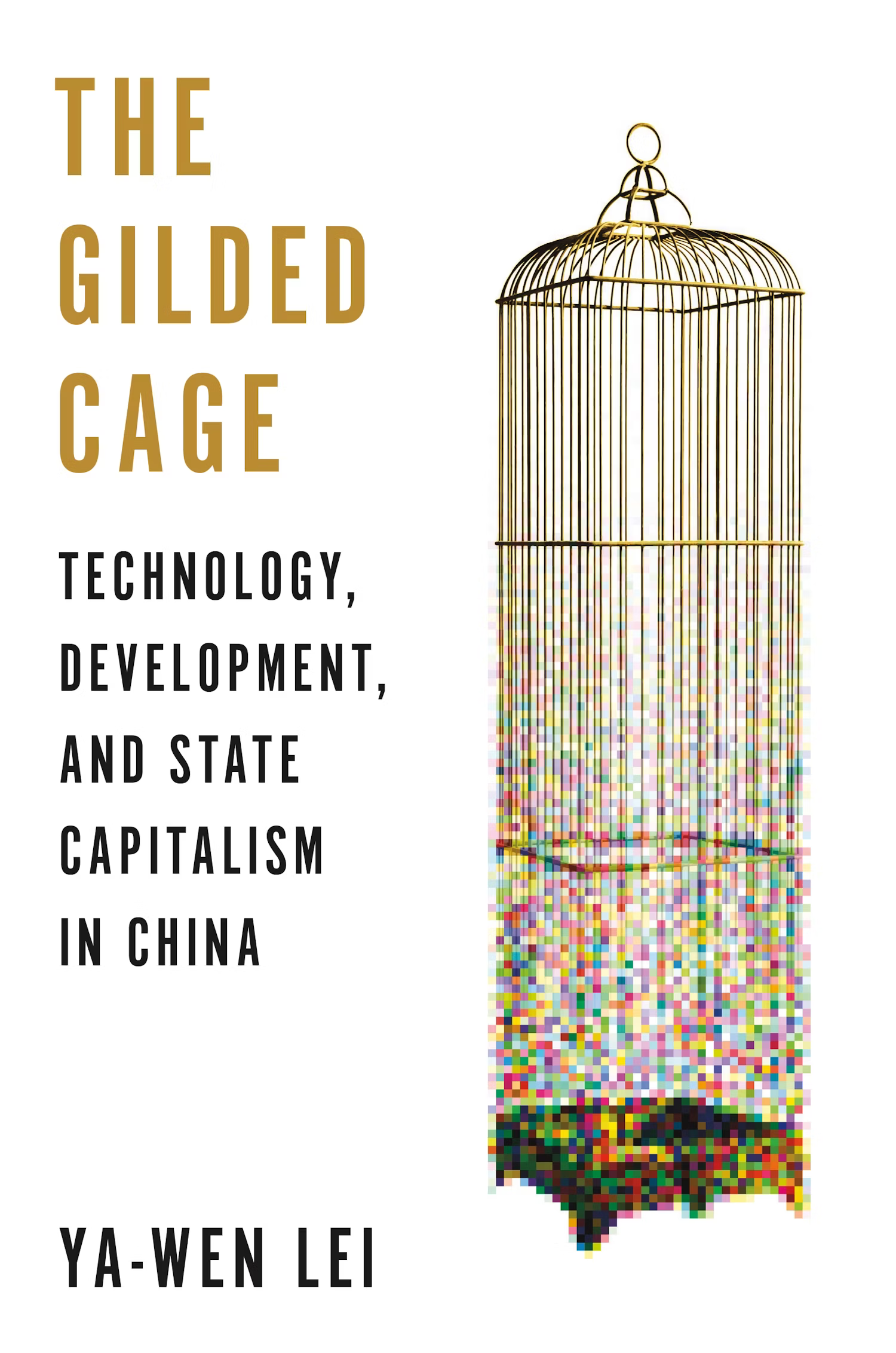
Jorge Ochoa: One thing I really like about the book is your effective and multi-layered use of metaphor. You take up the idea of a bird cage economy, a frame that Chinese state actors themselves use, and then you reformulate it as the gilded cage, evoking both the Gilded Age and even Max Weber’s idea of the iron cage. You talk about the new and old birds in relation to Joseph Schumpeter’s notion of creative destruction. What is your process of developing the metaphors offered in the Gilded Cage and how they relate to the core arguments of your book?
Ya-Wen Lei: When I was finishing the book, I didn’t really realize that these metaphors would become so important in my book. I knew about the way in which the Chinese government talk about like a bird and cage. And then perhaps in a different chapter, I wrote about new birds and old birds, and the way they use different kinds of legal and technical instruments to guide the economy. I just want to thank a lot of scholars who read my book. I organized a book workshop, and many people who read the first version of my book manuscript, they told me, “Ya-Wen, you know what? You should really make the metaphor central because what connects different chapters is really the idea of bird cage, bird and the cage.” So, a lot of people helped me in this process. They had different opinions on how I should actually revise my book manuscript, but all of them agreed that these metaphors should be central. I wouldn’t really credit myself. I should give credit to the scholars who helped me. In sociology, there are just so many scholars who are so generous, and I learned a lot from the process. I feel that when I was writing my first book, it’s easier because of the mentoring of my professors. But then for this one, it’s really difficult, especially the theoretical framing and how I should really abstract the empirical findings. In the end, my book workshop participants helped me to understand that the book is really about Weber’s process of rationalization—albeit a very extreme case of rationalization.
This also connects to my first book. We have a lot of debates about, in classical sociology especially, in certain traditions there are questions about how humans can be free from this rationalization process, and communicative rationality, proposed by Habermas, is a way to handle the problem of instrumental rationalization. The first book was actually about public sphere, communicative rationality. So, under certain political conditions, China had a public sphere. Then in the second book, it’s when this rationality, communicative rationality, declined. And then there is a really crazy pursuit of instrumental rationality, Weber’s idea of instrumental rationality. I see this as a project in which I show the rapid rise of instrumental rationality. In the end, the metaphor of cage worked for me to describe this expansion of instruments and instrumental rationality.
Jorge Ochoa: It was really well done. And it’s always nice to hear, and to be reminded, that it takes a village. Moving from metaphor to methodology, I appreciated how your approach is multi-scalar, bridging attention to macro-level changes and then more quotidian, everyday realities. It also moves across domains, so not only looking at the state, but also big tech, society, and their interplay. What insights does this multi-scalar, multi-domain approach enable? And were there any difficulties that stand out in studying such a vast terrain with various moving parts?
Ya-Wen Lei: Usually for people who don’t study the US, they have to describe the context because a lot of readers don’t have a lot of knowledge about the background. It’s inevitable. In the Chinese case, the Chinese state plays a central role in economic development and in everyday life. There is a tradition of the planned economy, and even after the market transition, the government has still played a very important role. So it’s impossible not to study the role of the state when you study anything about China. That means that I have to study the relationship between the state and business actors, as well as with labor and ordinary citizens. It’s very difficult sometimes, because it operates at so many levels, as you mentioned, and across different sectors. Sometimes one could easily get lost. It’s also possible that one writes analysis at macro-level without really linking how change or development at the highest level influences and interacts with changes that happen at another level. It’s very difficult to write things at this scale and across so many different levels. Sometimes I have to really step back and think. What is this story about? How do I actually link different moving parts? It’s really not easy. That’s why the book is so thick.
Jorge Ochoa: It’s well done. It’s nice to have a model of how to go about doing that methodologically but then also narratively. Your research delves into, among many other things, the experiences of workers—including, on the one hand, coding elites, and, on the other hand, gig platform workers like food couriers. How are these two sets of workers embedded within China’s technodevelopmental regime in similar or different ways? What are their different positions in the system?
Ya-Wen Lei: I began to work on the delivery workers because many of these people actually left factory jobs. In the US, we also have a lot of like Uber delivery workers. But in China this transformation happened so rapidly, so you see the direct movement of labor: factory workers who go to work in the platform economy. These are the people who really hate the factory jobs, but they feel that they could do well—many of them thought that they could do well in the newly developing platform economy. But in the end, they are really at the bottom of the digital economy. I wrote about their struggle. And with the coding elite, I was inspired by Marion Fourcade’s writing on coding elites from her piece in Annual Review of Sociology.
Jorge Ochoa: “The Society of Algorithms”?
Ya-Wen Lei: Yes. In that piece, she lumps coding elites together, including both engineers and also CEOs and professors. But then I try to study the stratification within the coding elite. From Foucault’s writing, one would assume that these coding elites are really elite, and they are the people who profit from digital capitalism or surveillance capitalism. But, in fact, they are still workers. They are still laborers in the capitalist system. They are positioned higher than the delivery workers. But I also show that there is a spectrum. Even among the coding elites, they are situated very differently within the digital economy. Even though they are considered as elites, they still don’t really have a lot of leverage in terms of negotiating with the entrepreneurs and the capitalists. I tried to write about the stratification within them. In fact, at the bottom of the coding elites, that group is very similar to delivery worker in terms of their salary. We usually only focus on like labor movements or collective actions organized by delivery workers. In sociology, we don’t really have a lot of studies on engineers, so I incorporate that part and also look at their tendency to organize collective actions. I’m also interested in how they think about their role in exploiting the delivery workers—because these engineers, many of them are the people who design these platforms, and they also understand the daily struggle of delivery workers—in how these coding elites perceive the struggle and think about labor problems.
Jorge Ochoa: It’s a great contribution. Throughout your book, you leverage various comparisons. Delving into that, how does the case of China compare to other cases of development? Or to other cases of state-tech relations, such as the relationship between big tech and the US government?
Ya-Wen Lei: I was also pushed by the participants of my book workshop to make this comparison more explicit. When I was finishing the book, I was really exhausted. I didn’t want to be so ambitious. But everyone asked me to. I couldn’t really do empirical research to compare, because the scale of the Chinese case is already so big, right? But all the senior scholars asked me to do some comparison based on literature. The US case, there are just so many similarities between the US case and the Chinese case. Although the US and China have very different political regimes. I try to make it clear that it’s not only about the comparison, but also that the origin of China’s digital economy is related to the contribution of US money, financial capital. China’s digital economy rose in a global context of neoliberalism in which US and China actually work together. That’s very different from the US-China relation today, that’s the previous stage. The Chinese government allowed tech companies in China to go IPO in the US. Also, even though the Chinese government had a lot of restriction on foreign investment in China directly in the Internet sector, they allowed the Internet companies to get global financial capital from the US. So, there is really a link.
Additionally, the Chinese entrepreneurs were inspired by US tech firms, and many of them had experiences working in the US. There was a clear transnational movement of ideas and people, and also capital. The US financial market made this possible. Then in the process of building their digital economy, the Chinese government was also inspired by the US regulatory environment. If you compare EU and the US, US tech regulation—there are not a lot of regulations—the level of regulation is actually relatively much lower than the EU. A lot of scholars point out it’s related to the fragmentation in political environment in the US. It’s very fragmented, and the government is not that powerful, and then tech companies were able to lobby the government. There was this very tolerant regulatory environment in the US. And in China, the government is extremely powerful but then they intentionally wanted to keep the regulatory environment, in the beginning, very tolerant. They want to learn from the US regulatory model. When they compare US and EU, they think the fact that there is a low degree of regulation helped the tech sector in the US to prosper. And in comparison, EU has so many regulations, and they think European companies suffer as a result. You can see some parallels that are quite similar in the Chinese case and the US case.
But in the end, in the Chinese case, I make it clear that the Chinese government realized that this very tolerant approach led to the growth of tech companies in China, and they worried that this new bird actually got out of their control. In the end, they began to crack down. That’s the US-China comparison. In the beginning, the Chinese government really wanted to learn from the regulatory environment approach from the US. I also compare China with the classical examples of developmental states in East Asia, especially South Korea and Taiwan. South Korea and Taiwan are very advanced in terms of technological development, for example, in the semiconductor sector. And now there are three major semiconductor manufacturers in the world, Intel in the US, Samsung in South Korea, and TSMC in Taiwan. The similarity between Taiwan, South Korea, and China is that they went through a rapid economic development process, and then they all shift to a technodevelopmental model. But I show that in South Korea and then in Taiwan, this shift was accompanied by the process of democratization. They actually were able to create a welfare state that includes more people at the same time. That process didn’t really create a huge proportion of left behind people or social groups. There was attention to equality, at least at that stage, and then there were like social protections for those groups. But in the process of development in China, they just sacrificed people who are at the bottom of society, and then they highly prioritize the talent who are perceived as having more contribution to technodevelopment. I try to show, perhaps because of the political regime, that this led to very different outcomes in terms of inequality and the inclusion of marginalized group and people who could be left behind.
Jorge Ochoa: The comparisons and then also the interconnections are super fascinating. In the conclusion of the book, you identify some contradictions that “have emerged in the process of China’s compressed technodevelopment” (301). What are some of those contradictions? And how do they continue to play out, including in the time since you’ve completed the book?
Ya-Wen Lei: The first contradiction, like in James C. Scott’s book, the Chinese government wants to use a lot of instruments to make things more legible. They want to see things and know things, and then use instruments to control things, to shape the development of things. But in the end, I try to show that a lot of people are playing the game. They just want to create better outcomes in terms of metrics. A lot of statistics, a lot of those classification outcomes, and the metric values are not really real. They actually deviate from reality. And the lower-level government officials know that. People realize that the way they do this wouldn’t achieve the goal. But then they are caught. They see these instruments as like a purpose in themselves, and they don’t really care too much about the difference between reality and appearance. When we talk about surveillance in China, a lot of descriptions, I don’t know if you’ve heard about the Social Credit System in China. They give everyone a social credit score. But in reality, a lot of things actually deviate from its intentions. There is a utopian view about how to use technology instruments to create something, but, in reality, things don’t really follow that. I show that there is a discrepancy between what they show and the reality. That’s the contradiction. I don’t think that has been changed a lot in China. In China, the government rely on those kinds of metrics, KPIs, and statistics so much. That’s the most major way they use to evaluate a lot of things. In other countries there could be for example, elections or something, you can evaluate people in different ways. Or you have elections to decide how things can be done, and who should get what, right? But in China there’s no elections and then this metric system became important in many spheres of life.
I also showed the contradiction between capital and the government. The government actually wanted to control the capital and then make things predictable. But in the process of developing their control, they actually almost lost control of the tech firms. On the one hand, they want to control. They want to structure things that every actor can follow. But on the other hand, they actually found that things went beyond their control. That’s why in 2020 they began to crack down on the tech sector. Then I also show the contradiction between capital and labor. You see this in many other countries as well, like the workers in the digital sector and then the digital companies. I also show the contradiction between citizens, or conflict between citizen and government. Some citizens were not happy with the way in which the government allocated resources. They feel their children are abandoned by the government because the government only appreciates people who are perceived as having higher value in the technodevelopmental model. There is a struggle between different actors.
Jorge Ochoa: Is there anything else you would like to highlight that you hope readers will take away from the book?
Ya-Wen Lei: For people who don’t study China or who don’t know a lot about China, I just want to make the transnational aspect clear, and to show that there is really a connection between the US case and the Chinese case. I want to highlight the transnational aspect of this story. This is one stage of globalization. But in recent years, we see new geopolitical tension. It is clear that we are at another stage of globalization. I also think sociologists tend to talk about neoliberalism, but we are at a different stage. I want to emphasize that my case happened under certain conditions, but that these macro, transnational conditions have been changing. And then it will be very interesting to see what new development happens at the new stage of globalization.
Jorge Ochoa: Thanks again for taking time to speak with me. The final question is, what are you working on next? Any exciting projects you’d like to preview for the SKAT newsletter readership?
Ya-Wen Lei: I just mentioned we are at a new stage of globalization that is characterized by intensified geopolitical tension. In the past, we take for granted the global division of labor. But now, there are different countries, different governments, including the Chinese government, the US government. You worked for the Biden administration. You know how they want to bring manufacturing back to the US? And it’s not only the Biden administration, but also the Trump administration from his first term. In my new project, I’m studying this effort to bring manufacturing back to the US in the semiconductor sector. There is something in sociology called transplantation, meaning that you move factories from one context to another context, cross-borders. In the 80s, in the 90s, at that time, Japanese car makers began to build factories in the US because of the US-Japan trade imbalance. In order to avoid tariff and access local market, the Japanese car makers began to build things in the US. And now I’m studying actually one aspect of the CHIPS and Science Act. I’m studying how the Taiwanese semiconductor company called TSMC began to build a facility in Phoenix, Arizona and the difficulty they encountered in this process. The Biden administration emphasized industrial policy. It’s learning from the successful example of the developmental state in East Asia. Under Biden’s administration, the US government began to essentially make important the role of the government in changing economic structure. I’m studying what happened in the process. And a few days ago, Trump pressured the Taiwanese company to invest more in the US. In order to make this industrial policy work, the government in the US and the Taiwanese company have to overcome a lot of organizational and also labor market difficulties. So, I’m studying the organizational process and how the factories have been built and operated, and the conflicts in the process, in this stage of globalization.
Jorge Ochoa: That’s great. I look forward to following your work. Thank you again.
Ya-Wen Lei: Thank you.
 Welcome to the official website of the Science, Knowledge, and Technology (SKAT) Section
Leave a comment