
Interviewed by Hayden J. Fulton on February 28th, 2025
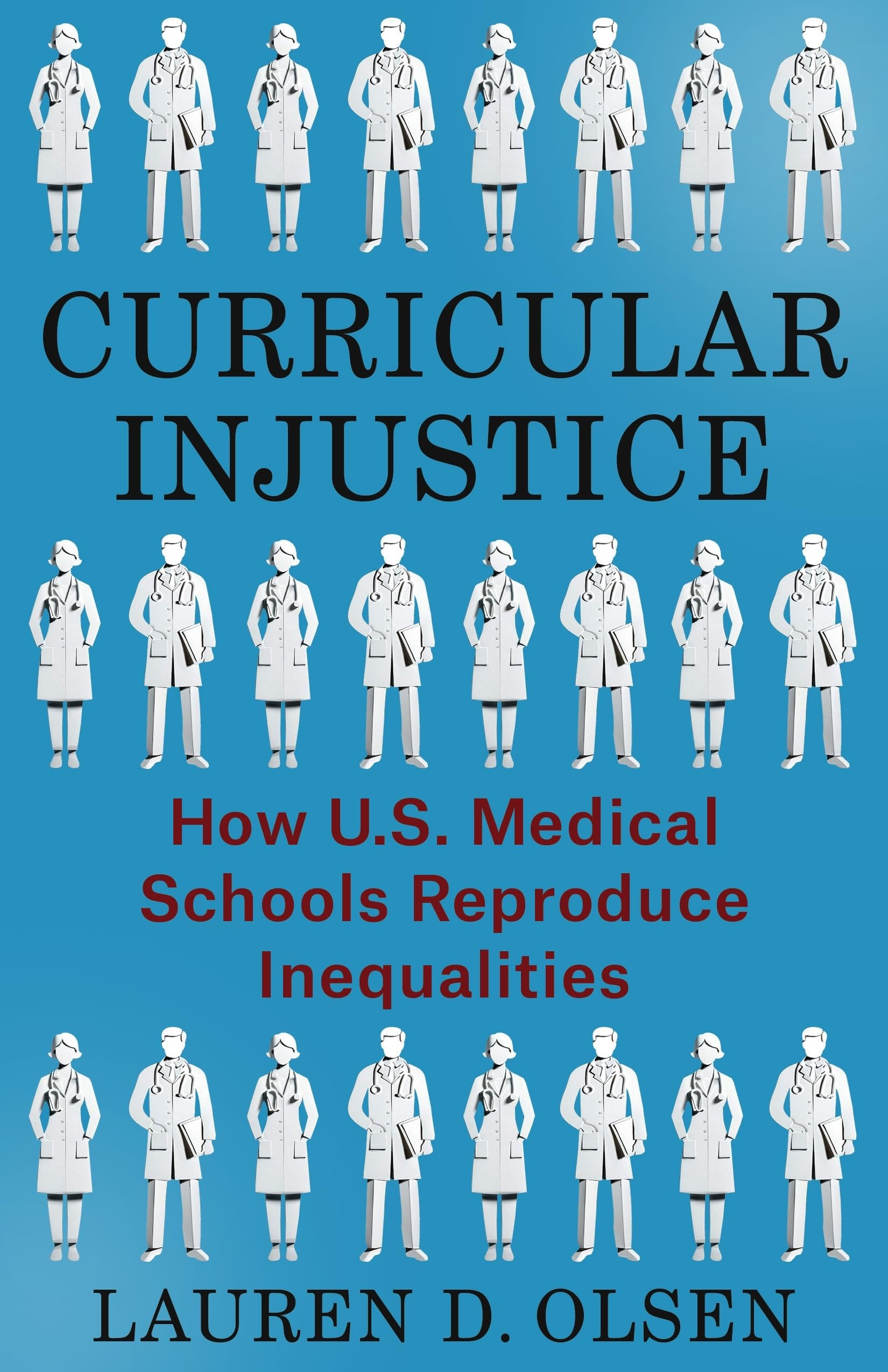
Lauren D. Olsen, PhD is an Assistant Professor of Sociology at Temple University. She is the author of Curricular Injustice: How U.S. Medical Schools Reproduce Inequalities (Columbia University Press 2024).
Hayden: To start off, I was wondering if you’d be able to speak to how you ended up interested in medical education and this specific case of how the social science and humanities are included in the medical curriculum?
Lauren: Yeah, I love that question. I guess it kind of depends on where I want to start the biography or the way I got here. I think the moment where I got really intellectually interested in thinking about how physicians understood their patients was immediately after graduating from college. I was freshly minted with a humanities heavy religion degree, and I started working in social work with people who had major mental illness, like DSM IV time, Axis I diagnoses. I worked in housing, but a lot of what I practically did on a day-to-day basis was accompanying the folks that I got to work with to different physician appointments. Because I spent so much time with them, I was very struck by the disconnect between their really culturally rich and religiously infused understandings of the world and what they were experiencing— and the very cold, calculated medicine-calibration moments at the doctor’s office, and the different ways in which they were dismissed. So sometimes it would be the physician just speaking to me rather than to them, even though they had a better understanding of their health history than I did. (especially as someone new to be working with them). Or, you know, just outright not listening to them, like, “OK, let’s refocus the interview: how is this medication impacting you here today?”
This is where it’s it depends where the biography starts. As a 21-year-old, I had, up until then, received the opposite medical care by virtue of being a child of two physicians. And I played a sport in college and so I really had access to a lot of doctors because of how universities love student-athletes. I went from having very privileged experiences in healthcare to witnessing people have a totally different reality and that only underscores the immense privilege that I had to get to first witness that at, you know, in my 20s.
Especially in this current political moment, I still very much believe in the power of the social sciences and humanities to make people more equitable and make people more humane. I got really interested in how the psychiatrist and other healthcare providers, in this particular case, were trained to work with patients from different backgrounds, and this was in New York City, so it was patients from all different backgrounds. I got really fascinated by how they learned to approach patients.
Hayden: In the preface you mentioned coming to this project through an interest in the “politics of knowledge application” or “the power struggles over whose voice counts in decisions over what knowledge is included (and excluded) in the values and practices of a professional workforce” (ix). I was wondering if you could speak to how thinking about medical education through this lens impacted how you approached the project?
Lauren: Yeah, I’m very indebted to Scott Frickel and Kelly Moore’s The New Political Sociology of Science: Institutions, Networks, and Power (2006). Frickel and Moore are drawing upon a legacy within science studies that conceptualizes thinking about science from a political sociology lens, thinking about the power struggles that are involved in setting agendas, whether it’s what new vaccines are produced or what doctors are learning. Thinking about the politics of knowledge application I was also drawing upon Janet Shim’s work on the politics of knowledge production and epidemiology, most notably elaborated in her book Heart Sick: The Politics of Risk, Inequality, and Heart Disease (2014).
A lot of the work that had been done on medical education before, it’s excellent and I love the work, but it often examines, especially in terms of curricula, the professional socialization that’s happening, whether explicitly in the context of the classroom or peer socialization. So, whether it’s top-down or bottom-up it tends to not necessarily focus on what is on the table to begin with regarding what students should be learning.
I have a particular bone to pick with this body of work with this one concept of the “hidden curriculum”. It gets thrown around lot, even more so among practitioners of medical education who appropriate a lot of sociological terms and then misuse them. And, in fact, one of the main scholars who transported this concept of the hidden curriculum into medical education, Fred Hafferty (2015), has been critical of how hidden curriculum has been used to mean both everything and therefore nothing. The hidden curriculum, though, in its original formulation, is really about the politics of knowledge application. It’s talking about the disconnect between how institutions show their values through where they put their financial resources, or what they signal with new buildings being constructed, or how they decorate their hallways, or the allocation of the budget, which may be disconnected from what they’re explicitly teaching in the classroom.
And in this whole hidden curriculum explains everything world they never talk about who’s making these decisions. I have one of my committee members, Amy Binder, to thank for this insight. It was early on in grad school when she was reading one of my early proposals, and I said something like “Medical education is trying to incorporate the humanities and social sciences,” and she was like, “Well, medical education like isn’t doing that, medical educators are doing that.” And so, “who are these people? Who are the actors behind this?” And that problem remains interesting to me.
The politics of knowledge application allowed me to really think about how decisions are being made at the professional level, at the level of the school, and in the classroom. I ended up organizing the book’s chapters in a particular way to think about how decisions are being made at these different levels of analysis. So going from the profession, to the school as an organization, to the classroom, to the clinical faculty that are in charge of the classroom. Then, actually thinking about students because students are the main voice of push back in this particular case, not just how they’re impacted, but how they might think about resisting.
Hayden: You mentioned how this ability to move between levels of analysis impacted your findings. I was wondering if you have any thoughts on how your methods impacted your ability to do that, specifically thinking about how many of the classic studies we have of medical socialization are looking at a specific medical school. Do you have any thoughts of how doing something different methodologically informed your findings?
Lauren: Yeah, I appreciate you saying that. I sometimes wished I was able to do an in-depth ethnography so I could see the nuances and interactive moments of these processes really play out, but, I really loved doing these comparative interviews across dozens of schools. I loved attending the AAMC’s (The Association of American Medical Colleges) annual conferences. I did that three years in a row. And I mean, talk about the politics of knowledge application. Seeing the panels and Q&A period was fascinating. I mean, one could do that at ASA too. You see different posturing or what topics get picked up or are like hot, and which ones weren’t. And then I also looked at the curricular documents at every MD-granting medical school at the time that I was doing the data collection (2015-2017). The interviews that I did were also comparative, thinking of social sciences and humanities scholars, and then the more MD-type clinical faculty as well as students. Analytically speaking, to kind of organize everything and get my bearings at first, it took a while because I also wanted to do a little bit of a historical tracing approach.
In terms of what that methodologically allowed me to do, I think it allowed me to see how, and it’s a little bit of an ironic point, but a lot of the folks that I spoke to at med schools talked about how every medical school was unique and had this unique culture. But a lot of that discussion was about how chaotic they were, and so many of the folks that I spoke to about medical education described this disorganized, chaotic working environment and had this feeling of, “Well, this must just be us,” like “We’re a, you know, crap show over here.” That is something that I love about any sort of comparative work. That was my third chapter about the disorganization of medical schools and it was the hardest for me to write because for the longest time I was trying to impose order on it, and trying to analytically be able to explain what was going on, and it took me a while to be like, no, that’s actually part of the point. There is a tremendous amount of flexibility for leaders when their organization is in disarray. And we know as well that in moments when things are in disarray that people with historical positions of privilege can easily just fall into positions of leadership. So, this methodological choice of interviewing folks from a bunch of different schools allowed for some breadth, but yeah, like I think you know that I always love the depth and the nuance of the detailed ethnographies, they are the most fun to read.
Hayden: I was wondering would you be able to speak a bit to the relationship between curricular dreams of the clinical faculty members you interviewed and the curricular injustices that you saw being played out in the medical schools?
Lauren: Yes. So in in terms of what I’m calling the “curricular dreams,” it is something where it’s almost like every idea is a good idea! All these ideas are on the table. Slices of the social sciences and humanities that are structural and critical, as if we as sociologists were like, “this is what I would love for medical students to learn,” which could be something akin to an understanding of how racism is embedded in the medical profession and still operative in a lot of the algorithms today. Those types of topics were on the table. From a humanities perspective, it would be like a lot of rigorous literary analysis, or these deep histories of gynecology as a specialty in their racist origins. And other topics that had more of a superficial engagement with the social sciences and humanities were also on the table.
But again, these dreams were really big. I believe that some of the medical educators involved in these conversations were operating with good intentions. The current cohort of leadership within medical schools came of age, professionally speaking, without having to engage with the humanities or social sciences at all. The promise of biomedicine was so extreme. There is a part of me that’s like if a pill could cure our social problems, that would be great. But we know, especially the SKAT section, that no such utopia will ever exist. But this cohort of leadership, without any actual academic background in these subfields, they’re seeing in their clinics patients who are not able to fill their prescriptions or distrust their expertise. Not in an RFK sense, but in, you exploited my community sense. The medical educators, with their experience as clinicians, were using what I call “clinical witnessing.” They’re seeing all the wait times, they’re seeing their visits be shortened, there are all of these things that they’re witnessing, but because of their privileged position, they’re not necessarily experiencing. I think that there was a real genuine desire behind their curricular dreams oriented around “what can we do to make this better?” So, I think that their end goal of wanting to cultivate humane and equitable doctors was legitimate.
But as I describe in terms of this process of knowledge application, at each step of going from these profession-wide curricular dreams, to incorporating them into standards by the accrediting body, to then getting to the level of school— of deciding OK when and who is teaching this? To then into the classroom, there are ways in which the social sciences and humanities get transformed, or distorted, or reduced, and those yield— to finally answer your question— curricular injustices, this idea of taking the social sciences at the curricular dreaming phase you could have this very robust understanding of how racism is embedded in the medical profession and medical knowledge itself, but what you end up teaching is essentially these stereotypes about racial or ethnic groups and their food preferences and how that would be important to know as doctors, because you need to counsel them on like how to eat properly or something like that. Or what’s worse, a lot of students, in particular, spoke about how they learned about biological race in the context of their lectures, and this is where medical student groups have been instrumental in pushing back against this version of curricular injustice. In fact, it was a student-run group out of the University of Washington that was able to change the racial correction for measuring kidney function (Estimate Glomerular Filtration Rate). They were able to remove the racial correction, which is so pivotal in thinking about when people, Black people in particular, can access timely kidney care.
That’s on the social sciences side. On the humanities side—and I think I mentioned this in the preface, but when I was transitioning from the dissertation into the book, I had to think a lot about how humanities fit into the story—one of the main ways that they fit into the story is that they essentially got transformed from these critical, reflective practices into therapeutic and celebratory practices. Like from, “How am I as a doctor contributing to inequalities?” or “What can I learn from this sustained engagement with a patient?” – they go from these really really big, very critical, very reflective ideas to what is essentially like a book club that is therapeutic for the students. And so again, how that’s connected to this overall story of thinking about curricular injustices is that it essentially makes the student feel like, “Oh, I’m in charge of my own mental health.” I mean, it’s very neoliberal. And we see it, I don’t know if your university does it, we just got access to the Calm app, and there’s all the different wellness industry metrics, where it’s like crap where you can, sometimes it’s like linked up with your insurance, and you can maybe earn points. I haven’t ever looked into it because I wouldn’t perform well on those metrics to get any money back [laughter]. They haven’t reached me yet. In this way the humanities end up getting transformed into placating the medical profession rather than challenging it or critiquing it. And again, thinking about the social sciences and humanities in concert, students are learning stereotypes, but then they’re also learning that they should just put their heads down and take care of their own mental health.
Hayden: In the conclusion, you give some examples of schools that are doing things differently. I was wondering if you would want to highlight these almost negative cases, what they look like, and how they’re different.
Lauren: Yeah, so again, thinking about the politics involved. At individual schools that are able to teach more aligned with some of these original curricular dreams, they have what I term “intellectual infrastructure” in the sense that people with expertise in the social sciences and humanities, it’s not just that they have a seat at the table, they’re able to help decide— “OK, you know we don’t want just half a day spent on race” Or “We don’t want our one week panel where patients with minoritized gender or sexuality backgrounds come in and talk about their experiences with healthcare/ their health.” They have people in positions of power to say, that the so-called sex week exoticizes and others gender and sexuality diversity and makes it feel like students conceptualize it as not the real curriculum, not what they actually had to learn (because otherwise they’d learn it from doctors). So, when people with legitimate expertise in these areas are looking at these curricular maps and are like “No, we need to be integrating discussions about heteronormativity throughout the curriculum.” This is where some schools that are doing it in an incredible way. They’re not just having, a social sciences thread that is like one to two days, a week… It’s actually in the different organ blocks. They will do things like talking about regulating sex, you know? They would talk about the colonialist origins of endocrinology when they get to that block, or pulmonology or…. You name it. And it allows students to critically think and understand how this knowledge has been produced and ways that they can better understand what they’re doing or what they’re prescribing in ways that will allow them to give better patient care.
Honestly, the main thing is thinking about this process, how one of the main disconnects is between the profession and the school. So, going from curricular dreams to the disorganization of a medical school. I think medical school leaders, like deans of med schools, have to be very deliberate about how they hire. Most medical schools, because so many of their faculty… the stat is like 89% of faculty at med schools are clinical because of the reimbursement structure. In many ways, a clinical faculty member is incredibly exploitable to a med school dean because so much of their reimbursement is coming from the clinic, the seeing patients part of things. So they’re like they can be in charge of the pre-clinical curriculum, regardless of their expertise, they expressed interest once… So in that sense, medical school deans need to be really deliberate about hiring social scientists and humanists to be involved in these types of conversations, as well as having the kind of power to say no, this is what the curriculum is going to be like.
Hayden: Throughout the text, you provide many examples of the really fraught position that humanities and social science educators are put in because of how their disciplines are conceptualized within the medical curriculum. While I haven’t taught in medical school, a lot of their experiences still really resonated with me as someone who’s taught pre-med students at the undergrad level. So, with that in mind, I was wondering, has this research in any way impacted your own pedagogy?
Lauren: It’s so funny that you say that. I have been teaching intro to sociology for pre-med students since grad school, really, since the MCAT started to include sociology. And, I mean, this is where this really great work done by STS folks, I’m thinking of Ana Viseu (2015) in particular, who talks about the care work that the humanities and social sciences do for STEM fields. When teaching pre-meds, we do so much care work in the context of how we are in relationship to these other fields. I’ve had students on the first day of classes being like “I see that your midterm is scheduled for this day. I have an orgo exam that day. So, do you want to change the day of your midterms? For the more important one?” I mean my favorite remark that I get every time I teach this is, “Oh, this was actually interesting.” Like it’s always these backhanded compliments of, “Oh, I didn’t realize that this was a legitimate field that would be relevant.” I mean, so much of my angle now is to hammer home to them, “do you know how hospitals work? You’re going to be exchanging your labor for a wage and be employees, right?”
I mean this is this is in the before times before the recent Trump administration dismantled all of our research infrastructure, and I will say I am really curious in this moment to think about how biomedical researchers and physicians might actually realign their politics now that their science is under threat. Very, very curious how this is going to play out, both with like union organizing and resisting and protesting.
In terms of impacting my pedagogy, one of the main things that I have come to realize is that you can’t bank on the med schools to teach them about racism. You can’t bank on the med schools teaching them about heteronormativity. I feel very committed to doing that. One of my Trojan horse approaches to this is that I like to assign like JAMA or New England Journal of Medicine articles that are critical social sciencey or humanitiesy as a way to boost the legitimacy in their eyes of these ideas and say like look, other doctors say this is important to highlight some of the kinds of things that that sociologists have been talking about.
And another thing that I do is I say to them that I’m going to be very critical of the medical profession in the course, but I start the course being critical of the sociology profession too. I assign Aldon Morris’ presidential address where he talks about how DuBois was excluded from the canon, and the recently published article by the historian Jenna Healey (2023) about Dr. Osler, who’s one of the founding four folks of American professional medicine at Johns Hopkins (He started residency programs and he’s noted for his humanism.) But she found he had an alter ego that would do a lot of hoaxes, and among them had a very anti indigenously racist piece that then circulated in these, private Osler Societies. But like anthropology and the social sciences are equally as implicated as medicine in terms of producing this racism. So, I try to be as critical of our field as well as the medical field to teach that as a practice.
Another thing that I do with the pedagogy is with hospitals and health care organizations I try to show them how they will be impacted, like it’s not just about patient care, it’s also that your lives will be impacted. So, I’ll show things about how trans and nonbinary students are treated or how they witness and experience chronic misgendering in the context of their rounding with attendings or the way that medical students who present as women are described relative to men or those types of things. I try to get them in there like, “Oh God I didn’t think that about that.” Another thing that I’ve done increasingly regarding the humanities is assigning poems that speak to some of the themes to really highlight how something that might only be 100 words could really make you think and reflect.
To the conscripted curriculum point, I take it very seriously to teach students about structural inequality so students who have experienced marginalization don’t feel like they have to be the ones to teach their peers about it. And that is something that I feel very committed to. That, and I designed the course to have this narrative arc where it’s like, dehumanization can happen really easily. And then show how, both in like how human brains might work in that we create schemas and shortcuts in our brains which can lead to stereotyping, to how the structures can remove responsibility from things, to then, particularly for med students, thinking about cutting into cadavers and that sort of thing.
Hayden: Outside of our individual classrooms, I was wondering if there’s anything else you’d like to add on how as social scientists we could advocate for the improvement of how our discipline is taught in medical education, especially right now in our current political climate?
Lauren: Yeah, this is something that I’ve been talking with, there’s a group of us in the Sociology of Health Professions Education Collaborative and we have been talking about how we need to create some sort of document. We’ve had a lot of conversations about how that would be approached and what that might look like. Part of the inspiration even predating our awful political moment here in the US comes from the UK, where sociologists came together and created an organization and a report that then informed and continues to structure the way that sociology is taught at the med schools there. And I say this a couple times in my book, but like, ASA has done nothing of the sort. And perhaps for good reason, as we were just talking about with the prior question, there is a lot of structural marginalization of social scientists, so who’s to say that if we were to produce something like this, the medical profession would listen? But I do think that with a lot of the current crumbling of institutions and potential realignments that could happen, it would be great to at least try.
And there’s this group that does health humanities stuff, and so I was talking to some folks in that group about potentially setting up a workshop style meeting between social scientists and humanists –where the end goal would to gain some consensus, or at least ideas on the table about what we would actually want to advocate for. And I have a dream of working with the realities of not just medical schools, but the realities of working people today. I’m imagining gradations, so if you can only do one thing, please just do this, and then if you are able to hire, this could be a thing that you could look into. And I think that doing something like that could again be incredibly practically relevant. Laura Hirshfield, she’s this awesome scholar who works in a medical school, she and I’ve been talking probably the most about this, and she was saying how, there’s going to just be so much strategic translation that needs to happen, and so I think there will be some challenges there, but this work is something that is needed and is possible. I actually really like the idea of thinking about going beyond the sociologists of health professions education and thinking about sociologists more broadly, I’d want to know: what would you want your doctor to know in terms of providing health care?
Hayden: Thank you so much for your work and taking the time to speak with me today. So, the last question is what are you working on now? What should the SKAT readers look out for?
Lauren: What I’m currently obsessed with is related to what we were talking about before with pre-med students. Specifically, pre-med stress. So, the pre-meds that I work with think that they’re the most stressed group. I’ve not been able to find any data to support that claim, more in the sense that the data is sort of sparse. Even in one thing I was able to find from the Healthy Mind Study, it’s actually arts majors that are more stressed in terms of the way that they measure it relative to pre-med students. Currently I am working on a project thinking about pre-med stress, I really want to do some sort of nationally comparative project thinking about school specific resources, working with a few other scholars at different types of institutions, like a small liberal arts school, private research university, or HBCU, in thinking about how an organization structures resources could impact students. And within that sort of domain, I’d like to think more about interdisciplinarity on campuses and how the different organizational forms and flavors that interdisciplinarity can take. Is it an interdisciplinary department versus do students need to actually just have a double major? Thinking again, what are the organizational barriers or constraints, on the one hand, or opportunities, on the other, that allow for students to come to medical school already with a better understanding of how the social world works? And to that end, I don’t know if this is just because I’m annoyed by the amount of times I’m asked to move my midterms, but I am really interested in the care work that humanists and social scientists do on college campuses. So that’s one project.
The other project that would be more ethnographic—and that I’m really excited to get off the ground—is about the student-run free clinic that a lot of medical schools have. I’m really fascinated by service learning, and again, the tremendous potential that it could have to how to have medical students do good work, but also the potential problems in terms of voyeurism, or revolving doors of care, or just another thing a doctor or a medical student might check off their CV. I feel like service learning could be done pretty poorly. I mean, one of my biggest limitations in my work is that patients’ voices aren’t a big part of it, and I really would like to hear what they think about some of this stuff.
 Welcome to the official website of the Science, Knowledge, and Technology (SKAT) Section
Leave a comment