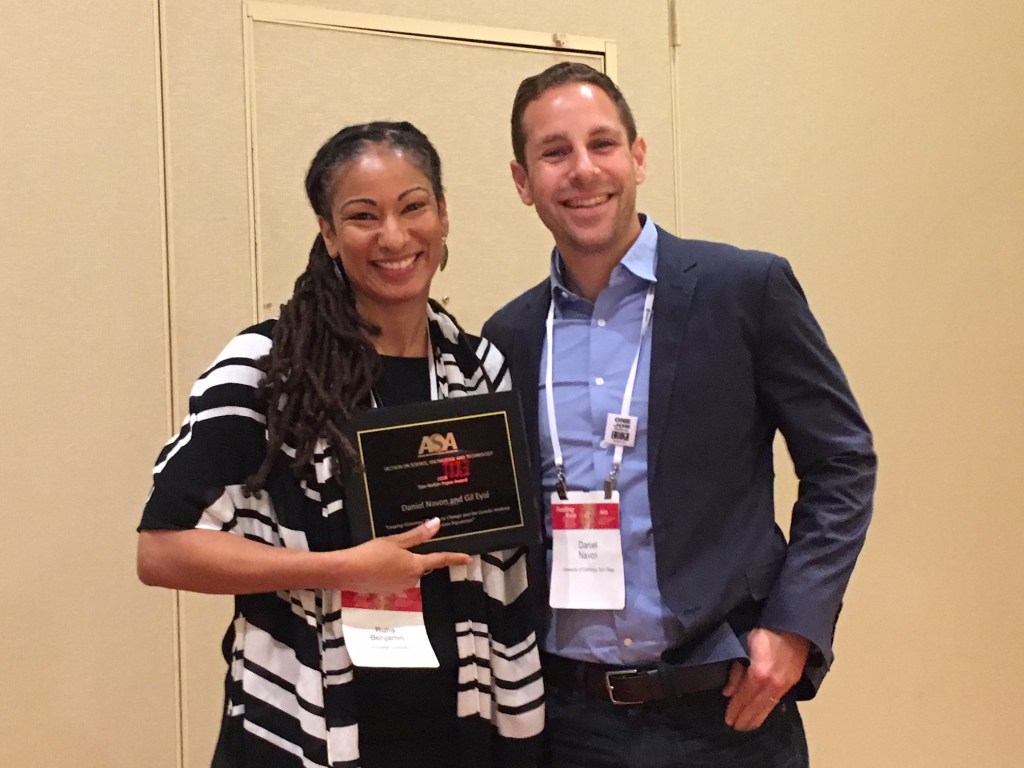
The SKAT section has five awards that are given out each year at the ASA Annual Meeting:
- Robert K. Merton Book Award
- Star-Nelkin Paper Award
- Hacker-Mullins Student Paper Award
- Emancipatory Practice Award
- Ida B. Wells-Troy Duster Award
The call for nominations for the 2026 awards is now open. Please find the information below.
Robert K. Merton Book Award
Deadline: 1/15/2026
The Science, Knowledge, and Technology Section invites nominations (including self-nominations) for the 2026 Robert K. Merton Book Award. The award is given annually in recognition of an outstanding book on science, knowledge, and/or technology published during the preceding two years (2025 or 2024). Single or multi-authored works are eligible, but not edited volumes. The winner will be honored at the ASA Annual Meeting in New York City (August 2026).
The deadline for nominations is January 15, 2026. Nominations or requests for more information should be sent to the committee chair, Larry Au (lau1@ccny.cuny.edu). No nominating statement or letter is required (nor will be considered as part of the committee’s review of nominations).
Print copies of nominated books must be received by all committee members by February 15, 2026. Please contact the committee chair for mailing addresses. All nominees must be registered members of the ASA and SKAT to be considered for this award.
Star Nelkin Award
Deadline: 3/15/26
The Science, Knowledge, and Technology Section of the American Sociological Association invites nominations for the 2026 Star-Nelkin Paper Award. ASA-SKAT welcomes nominations (including self-nominations) of published articles that advance the field of sociology of science, knowledge, and technology. To be eligible, an article’s earliest date of publication in a scholarly journal (whether online or in print) must have been in 2024 or 2025. The winner will be honored at the ASA Annual Meeting in New York (August 2026). Please complete this form to nominate an article by March 15, 2026. Contact the committee chair, Sharla Alegria (sharla.alegria@utoronto.ca) with any questions. No nominating statement or letter is required (nor will be considered as part of the committee’s review of nominations). We especially encourage submissions of work written by scholars who identify as Black, Indigenous, or People of Color (BIPOC). Send any requests for more information to the award committee chair. Please note that all nominees must be registered members of the ASA and SKAT to be considered for this award.
Hacker-Mullins Student Paper Award
Deadline: 3/15/2026
The Science, Knowledge and Technology Section invites submissions for the 2026 Hacker-Mullins Graduate Student Paper Award. The winner will be honored at the ASA meetings in New York City (August 2026) and will receive a certificate and a $350 monetary prize. The deadline for submissions is March 15, 2026.
We welcome and encourage self-nominations. We especially encourage submissions of work written by scholars who identify as Black, Indigenous, or People of Color (BIPOC). To be eligible, the primary author must be a student at the time of the paper’s writing, and a student or postdoc at time of submission to the award committee. Published and unpublished papers of no more than 10,000 words (excluding references) are accepted; if published, the article must have been published no earlier than 2024. Each student may submit only one paper in which they are the primary author. For papers co-authored with faculty members, a paper is eligible if the graduate student of the paper is the primary author and the non-student author must attest to the student’s primary role in the design, execution, and writing of the paper.
Please send a PDF of the nominated paper to the committee chair, Zach Griffen, at zachary.griffen@nyu.edu. In the submission email, please include information about the status and provenance of the paper: if it has benefitted from peer review, if it has been considered or accepted for publication, or if it is an unpublished part of a dissertation or other research project. In addition, please indicate whether the student author has achieved PhD candidacy. These are not requirements for the award but will assist the committee in considering equity.
All nominees must be registered members of both ASA and SKAT to be considered for this award. Student membership is at a reduced rate. If this presents a financial hardship for you, please contact the chair (Zach Griffen – zachary.griffen@nyu.edu) to discuss options.
2026 Emancipatory Practice Award
Call for Nominations
Deadline: 3/15/2026
The Science, Knowledge, and Technology (SKAT) Section invites nominations for the Emancipatory Practice in SKAT Award. This award recognizes the pursuit of anti-racist social change, either by supporting Black, Indigenous, and People of Color (BIPOC) communities within our subfield or by supporting broader public engagement with SKAT knowledge and principles. SKAT research encompasses a broad range of topics, including the production, circulation, and understanding of scientific, technical and medical knowledge, the social shaping and impact of science and technology, and impact of science and technology on society. Nominations are welcome for creative contributions and work not traditionally recognized in the academy, including mentoring, public engagement through social media/blogs, activist leadership, artistic works including films, and social justice curriculum development.
The emancipatory practice award alternates between non-academic and academic recipients. In even years, nominees should be non-academic, and in odd years, they should be academic. Because this is a call for 2026, the committee invites non-academic nominees. If a collective contribution is nominated, 1-2 leaders should be identified to receive the award. This award is open to all persons regardless of identity. Black, Indigenous, and People of Color are especially encouraged to apply. The Emancipatory Practice award comes with a $250 prize. SKAT welcomes nominations for this award of people who are not currently SKAT (or ASA) members.
Nomination letters should name a person nominated and describe the relevant contribution the nominee has made, specifying how the contribution supports BIPOC communities through SKAT or has implications for public engagement with SKAT knowledge in the spirit of anti-racism. Nomination letters should be no more than 2 single-space pages in length, and if relevant, the nomination letter should include a link to a website, blog, or other social media platform.
Nominations should be emailed to Shannon Malone Gonzalez (sgonzalez@unc.edu), Chair of the Anti-Racism in SKAT Committee. Please include the contact information of the nominator for potential follow-up. Self-nominations are welcome and encouraged. SKAT also welcomes nominations for this award from people who are not currently SKAT (or ASA) members.
2026 Ida B. Wells-Troy Duster Paper Award for Early Career Scholars
Deadline: 3/15/2026
The Science, Knowledge, and Technology (SKAT) Section invites nominations for written scholarship that develops understanding of Black, African American, or Indigenous intersections with science, knowledge, and technology in the spirit of anti-racism. The award honors sociologist Troy Duster (past President of ASA, and mentor to many), and his pathbreaking grandmother Ida B. Wells. Priority will be given to work that, in the tradition of both Wells and Duster, involves pioneering investigation of neglected areas of social injustice. Early career pre-tenure scholars are eligible for this award. This award is open to all persons regardless of identity. Black, Indigenous, and People of Color (BIPOC) are especially encouraged to apply. Eligible works include work in progress and published articles and chapters of no more than 10,000 words. Published works must have publication dates of no more than two years prior to award year (2024 for the 2026 award). The Wells-Duster Award comes with a $500 prize.
SKAT welcomes nominations (and encourages self-nominations) for this award from people who are not currently SKAT (or ASA) members. The award will come with membership in the SKAT section for one year if the selected recipient is an ASA member. Self-nominations are especially encouraged from students, postdoctoral scholars, and those in contingent or short-term academic positions. Nominees may put forward their work for consideration for this award and for any of the other SKAT awards at the same time.
The nominating statement should (a) briefly describe the written work; (b) summarize how it develops an understanding of Black, African American or Indigenous intersections with SKAT; and (c) explain what makes it a pioneering investigation of a neglected area of social injustice. The statement must also briefly describe the nominee’s current position. If the work has multiple authors, specify which author is nominated and highlight the contributions of the nominee to the design, execution, and writing of the work in the nominating statement. Please send nominated work and the brief nominating statement in one PDF document, via email, to Shannon Malone Gonzalez (sgonzalez@unc.edu), Chair of the Anti-Racism in SKAT Committee.
 Welcome to the official website of the Science, Knowledge, and Technology (SKAT) Section