Interviewed by Jeba Humayra Prithwi on October 30, 2025.

Ulises A. Mejias is a professor in the Communication Studies department at SUNY Oswego and a recipient of the SUNY Chancellor’s Award for Excellence in Scholarship. His research interests include critical data studies, philosophy and sociology of technology, and political economy of digital media. He’s on the board of directors of Humanities New York and on the advisory board of the Center on Privacy & Technology at Georgetown Law.
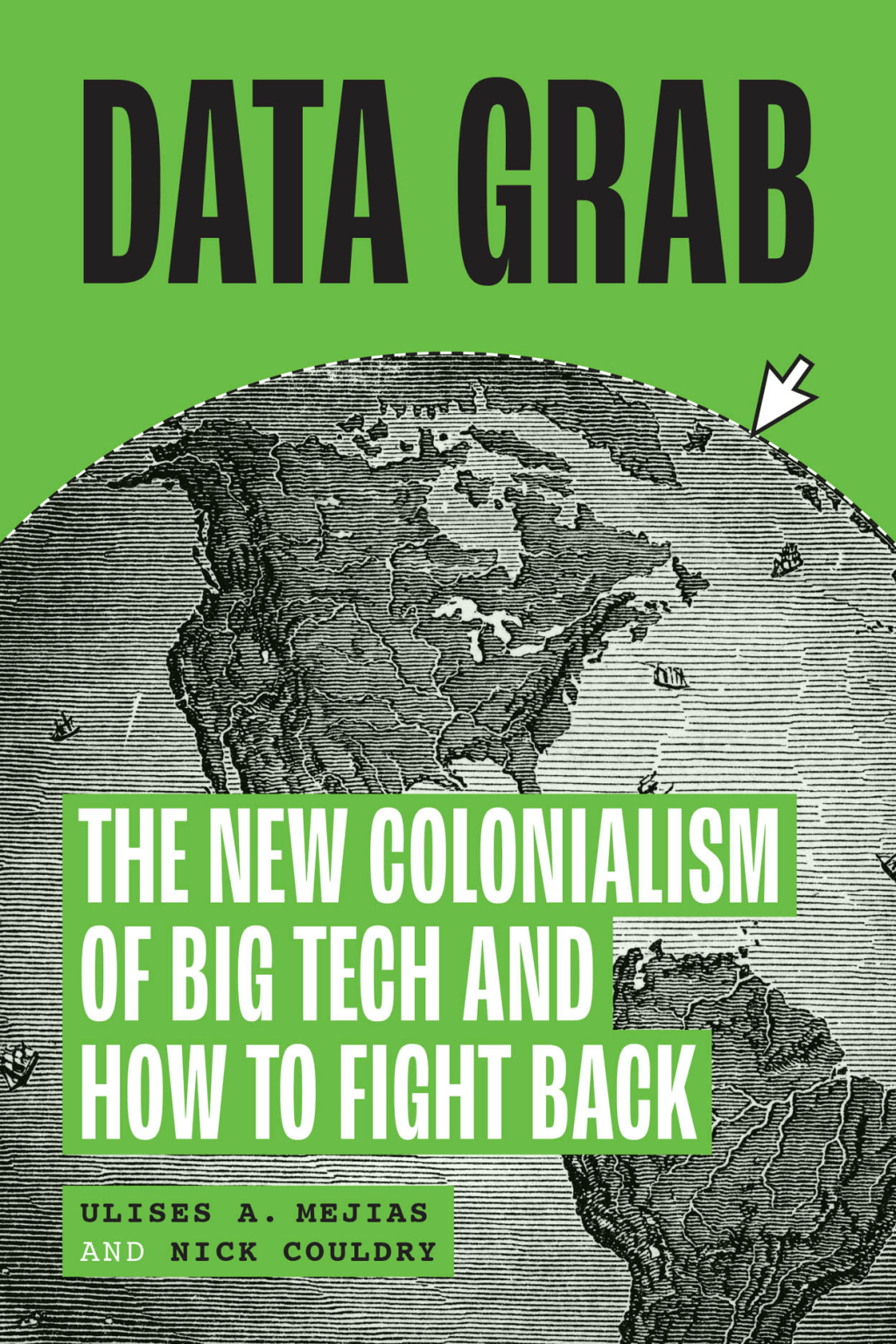
Jeba: Thank you for taking the time for this interview. I thoroughly enjoyed reading Data Grab: The New Colonialism of Big Tech and How to Fight Back, and it will play an important role in shaping my own research trajectory. To begin, could you share how you first became interested in the core questions you take up in the book? And relatedly, how does this project connect to your earlier work, The Costs of Connection: How Data Is Colonizing Human Life and Appropriating It for Capitalism?
Ulises: Thank you for inviting me and for your thoughtful descriptions of my work. I should begin by noting that this is co-authored research I developed with my colleague, Nick Couldry, from the London School of Economics. In terms of where the ideas originated, I’m originally from Mexico, although I’ve been living in the United States for more than half of my life. But being from the Global South has profoundly shaped my interests and my understanding of colonialism, and the lived experience of it in our day and age.
More specifically, the idea for this project emerged out of a transhistorical comparison of the past and the present. One day I was reading the Requerimiento, which we discuss in our work. The Requerimiento was a Spanish document that colonizers would read aloud before conquering a city or village in the so-called New World. The document essentially outlined what they were about to do to the colonized. It said something like: We’re going to enter your territory, take possession of it, seize your property; if you resist, we might enslave you and your family, and everything you own now belongs to us. Which is quite an outlandish statement.
But the other interesting thing about it is that it was read in Spanish to populations who did not speak Spanish. As I revisited this document, it suddenly struck me how similar this felt to the experience of reading the terms of use we are asked to accept whenever we install a new app or software. Those terms are also legal documents, written in highly abstract language that is extremely difficult for ordinary users to understand. And yet, by clicking “accept,” we are entering into a binding contract, one that creates a relationship defined by extraction and exploitation.
So, from that, I started to think about the correspondence between the colonial past and the capitalist present. Around that time, I had the good fortune of beginning a collaboration with Nick Couldry. When I shared these early ideas with him, he immediately saw the potential of this framing. Together, we began developing what became our conceptualization of data colonialism, a lens for understanding what is happening with data today.
Our central thesis is that what we are witnessing is a new form of colonialism. It is not about seizing land or natural resources; it is about capturing data, data from our everyday lives, which is extracted and used primarily to generate wealth and profit. This extraction unfolds within deeply unequal relationships that benefit corporations far more than they benefit individuals. And beyond profit, this data is used to establish new forms of social control. States may benefit from it, but so do corporations, whether through enhanced surveillance or new ways of transforming information into wealth and power.
Nick and I wrote an article based on these ideas, and then a book. Our first book on this topic, The Costs of Connection, was published in 2019 by Stanford University Press. Afterward, Penguin UK approached us with the idea of adapting the core arguments, originally written as an academic study, for a broader public audience. We were very excited about that opportunity, and that is how Data Grab emerged. It’s a more accessible version of our earlier work, published by Penguin in the UK, by the University of Chicago Press in the U.S., and by additional presses in Germany, Korea, and elsewhere. In that sense, Data Grab is an extension of The Costs of Connection, but written with a wider readership in mind.
Jeba: One aspect I really appreciated in Data Grab is your argument that what seems like a sudden digital revolution is in fact a continuation of centuries-long patterns of colonial extraction, where violence has become “frictionless.” You use the metaphor of two rivers, historic colonialism and data colonialism, now converging, with the new river accelerating the force of the old. Along the way, you develop related concepts such as “data territories” and the “social quantification sector,” and you frame data colonialism through the 4X model (Explore, Exploit, Expand, Exterminate). Could you walk us through your process of developing these conceptual tools and explain how they connect to the book’s core arguments? And why, in your view, is it important to describe the digital order as colonialism rather than simply as capitalism or surveillance?
Ulises: Certainly, yes. Well, neither Nick nor I are historians of colonialism in a formal academic sense. Nick is a media sociologist. I am a somewhat interdisciplinary scholar working across media and data studies, philosophy of technology, and the political economy of digital media. When we began this project and started to explore the history of colonialism, we had to learn a tremendous amount through that process.
One of the long-standing arguments in post-colonial literature is that you cannot understand capitalism without understanding colonialism. That realization is what led us to the metaphor of the two rivers converging. There is simply no capitalism without colonialism. Very directly, the wealth accumulated through colonial exploitation financed the plantations and the early factories that made industrial capitalism possible. That legacy continues to shape our world today. When we look at racism, or even at the roots of contemporary terrorism, there is always a colonial subtext, patterns established in the past that continue to structure the present.
That has essentially been the core of our project. Tracing these transhistorical continuities and understanding how the past lives on in the present. Many scholars before us have made this point, especially development theorists and postcolonial thinkers who argue that to understand our modern world, we must examine what was inherited from colonialism. Colonialism laid much of the foundation for how we understand capitalism and neoliberalism today.
Our contribution is to extend that analysis to the domain of data. We wanted to follow these continuities across history, which is why we began developing conceptual tools to make sense of the digital present. One of these is the concept of data territories. Historical colonialism relied on acquiring physical territories. Today, territorial acquisition looks different; it is not geographical, but digital. We now have new kinds of territories being acquired, and they play a crucial role in the emerging global order.
If we think about the major platforms we use every day, Facebook, Instagram, TikTok, X, we can think of each as a new kind of data territory. These platforms have boundaries, they have rules, and when we enter them, we are asked to accept a new constitution, so to speak: their terms of service. Unlike historic colonial constitutions that were written on paper, these new constitutions are written in software and code. But the effect is the same; once inside these territories, our actions are governed by the platform’s laws and architecture. What we can and cannot do is prescribed by that code.
And once we enter these territories, we are drawn into social relations of extractivism. By agreeing to the platform’s rules, we allow the owners of that territory to track us, collect data from us, analyze it, and then use it to determine what content we see, whether advertisements or posts from other users. All of this is made possible by our consent to the rules of these new digital territories.
That’s where this concept of data territories comes in. Other scholars have explored similar ideas, but we tried to give the term a very specific definition within the context of data colonialism: these are the new territories, the new zones of extraction and exploitation, where contemporary colonial dynamics unfold.
And, of course, that immediately raises the question: Who owns these territories? This is what led us to develop the idea of the social quantification sector. It’s easy to focus only on the Big Tech corporations that dominate these spaces, Google, Meta, Amazon, Apple, and their Chinese counterparts. As we can discuss later, we now live in a kind of bipolar colonial world, where both Silicon Valley and the United States on one side, and Chinese companies and the Chinese Communist Party on the other, play central roles in shaping this emerging order.
But the concept of the social quantification sector allows us to look beyond those major players. It includes not only the corporations whose CEOs we are familiar with, but also the countless smaller companies and government institutions that are embedded in this landscape. These might be hardware manufacturers, software developers, startups fueled by venture capital even before they turn a profit, or the state agencies responsible for regulating, or attempting to regulate, this ecosystem. We wanted an umbrella term that could bring together all of these actors.
At the end of the day, what unites this sector is that everyone involved is engaged in quantifying the social: turning our everyday activities into data that can be analyzed, monetized, and converted into profit. They bring aspects of life that were once outside the economy into the economy through datafication and monetization. That is the logic behind the concept.
Another concept we developed, which we think is important for understanding these dynamics, is the 4X model. We actually borrowed this from the world of video games, specifically, strategy games. In order to succeed in those games, players rely on a 4X approach: explore, expand, exploit and exterminate. If you’ve played strategy games, you’ll recognize how central these actions are to conquering the virtual world. Strategy video games are very colonial in that sense. You engage in these strategies to conquer the virtual world that you are presented with.
It occurred to us that this model maps almost perfectly onto the playbook of colonialism. Colonizers began by exploring, by “discovering” new worlds. Next came expansion, as they sought to enlarge their territorial control by founding more colonies. They then exploited those worlds by establishing colonies and extraction zones whose wealth could be funneled back to the centers of empire. And finally, they had to exterminate resistance, whether through physical violence or symbolic violence, such as suppressing Indigenous knowledge systems that challenged the colonial worldview.
So the 4X framework mirrors the fundamental steps of colonial expansion, and we found it a useful way of explaining how similar logics operate in the era of data colonialism as well. That was the thinking behind these models and concepts.
Jeba: Moving to methodology, could you describe your methodological approach? And in doing so, did you encounter any particular challenges along the way?
Ulises: Well, yes, that’s an interesting question, because in some ways Nick and I were trying to do something that is often met with a certain degree of skepticism today. We were attempting to build a meta-theory. In other words, we wanted to develop a framework capable of explaining vast transformations in our social order, transformations driven by very specific technological developments.
As we began this work, we realized that such a framework could help us understand what is happening from a distant, critical vantage point, a perspective that requires some analytical space between ourselves and the phenomena we are studying. And we were comfortable with that approach because we hoped that if the framework proved useful, other scholars would take it up and apply it to particular contexts. They could conduct detailed empirical studies, using our model to examine how data colonialism unfolds in different regions and communities.
We were always very aware that there is no single, uniform form of colonialism. Historically, that has never been the case. Colonialism in my native Mexico looked very different from colonialism in India. So, we never wanted to claim that one model explains everything.
What we did argue, however, is that despite these enormous contextual differences, colonial formations share a common historical function: they extract and they dispossess. Regardless of geography or historical moment, the core purpose has always been extraction. Once we identified that continuity, we felt comfortable offering a broad, general framework, while leaving the work of detailed case studies to researchers who are embedded in those specific contexts and best positioned to examine them.
This is a rather long way of saying that, methodologically, we were operating at the level of theory. We were interested in global worldviews. Our approach was broadly theoretical rather than driven by a specific empirical methodology. If we had to name one, critical theory or critical sociology might best describe it, but we were not bound by a tightly defined method.
For that reason, the main challenges we faced were conceptual. We were trying to build a comprehensive theoretical framework capable of explaining what we saw happening globally. The difficulty wasn’t in applying a specific method to a specific site; it was in crafting a theory broad enough to make sense of these large-scale transformations without erasing local differences.
Jeba: I really appreciated your introduction of the concept of a new “colonial class,” the social quantification sector. Could you explain this idea for SKAT readers and discuss why it offers a more precise lens than familiar terms such as “Big Tech” or “surveillance capitalism”?
Ulises: Yes, well, we certainly draw on various ideas and models, including surveillance capitalism, which we find useful. But we also believe that many of these frameworks overlook colonial history in ways that our approach tries to foreground. For us, the core premise is that we cannot understand the present without looking through the lens of the past.
One point I always emphasize is that colonialism was never solely a corporate enterprise or solely a state enterprise. From the very beginning, it was a partnership between the two. The Spanish had institutions such as the Casa de la Contratación de las Indias. Later, in the British Empire, we find clear examples like the East India Company. These were colonial corporations operating under state sanction, backed by state funding, and working in close partnership with imperial administrations.
That historical reality helps us understand where this new “colonial class” comes from. It is easy to focus on the Big Tech corporations, the handful of dominant firms and their CEOs, and to point fingers at them. And we should. But this lens also helps us see the deeper partnerships that make their power possible. Take Elon Musk, for example. He’s often portrayed as a lone, “genius entrepreneur,” someone who built an empire single-handedly. But his companies have benefited enormously from state contracts and government subsidies that enabled their rise.
We could say the same about Zuckerberg and other prominent figures in today’s tech landscape. Their power has grown not only because of their corporate activities but also because of the partnerships they maintain with the U.S. government. These partnerships, I think, are crucial because they allow us to understand the social quantification sector not as purely private or purely public, but as a hybrid formation, a space where corporate and state interests continuously intersect. When we examine the work being done in this sector, China offers a particularly clear example on the Asian side of how tightly the state and private companies can be intertwined.
Thinking about it this way helps us use the concept of the social quantification sector to trace these collaborations and situate them within a broader historical trajectory. It becomes evident that none of this has ever been solely about capitalism, or solely about business, or solely about colonial or imperial interventions. What we see, historically and in the present, is always a combination of state interests and corporate interests working together.
Jeba: You emphasize that the problem is not data itself, which remains essential for science and collective well-being, but the unequal, extractive social order under which it is collected and used. You also stress that resistance must be both imaginative and practical, rooted in Indigenous, feminist, and community-led frameworks. At the same time, you warn that perhaps the deepest danger of data colonialism is not only the erosion of autonomy but the loss of even imagining freedom itself. You write that “we cannot build resistance without solidarity, but that means being clear from the start about how we have individually contributed to this system in various ways” (p. 208). Could you elaborate on what it means to “decolonize data” in practice?
Ulises: In our work we try to be very clear that we are not “anti-data.” We are not claiming that data itself is bad. Our definition of data colonialism is very specific. It describes a social order in which data is extracted from our everyday lives for the purpose of generating wealth in ways that deepen inequality and enable new forms of social control. It is when data is used in these extractivist ways, to enrich some while constraining others, that we see a serious problem.
Another important point is that when we look at the history of colonialism, we have to remember that it was never only about conquering land or seizing natural resources. Colonialism also aimed to conquer the minds of the colonized, to make a Eurocentric, white, male worldview appear as the only rational way to understand and reorganize the world socially and economically. Doing that required suppressing or erasing other forms of knowledge: Indigenous knowledge systems, knowledge produced by women, by people of color, and by communities whose epistemologies challenged the colonial worldview.
That is the history of colonialism, and we continue to see its imprint today in data colonialism. Data colonialism involves all of us to some degree, but our argument is that its costs fall disproportionately on the same groups who have historically borne the brunt of colonialism, people of color, women, the poor, and communities in the Global South. Data colonialism is not a new form of colonialism emerging on a blank slate. It is built on centuries of discrimination, bias, and oppression that continue to structure social life.
When we look, for instance, at what’s happening in the gig economy, many gig workers in the Global North are migrant workers. People often enter gig work because they cannot access formal employment. Once they enter these data territories, their wages can be algorithmically depressed, now increasingly through AI systems. They can be pushed into precarious, exploitative forms of employment with little protection. So again, we see marginalized populations paying a disproportionately high price for the new data order.
Which brings us to the question of resistance. Here, we draw inspiration from activists in Latin America who have shown us for many decades that to decolonize our conditions, we need to operate at three different levels. We need to fight within the system, the colonial and capitalist system that we inhabit. We need to fight against it. And also, we need to fight beyond it.
And so, within the system, we need to participate in mainstream politics, as frustrating as that can be today. We have to keep putting pressure on governments and elected officials to develop solutions that serve us, the people who voted for them, rather than primarily serving corporations, the people who fund them. That is what it means to fight within the system.
We are also seeing important forms of dissent emerging inside corporations, people working in big tech, people working across the social quantification sector, who are saying, “I’m not comfortable with this project my company is pursuing.” These acts of internal resistance matter. They are part of the struggle within the system.
But, of course, the system is not going to reform itself on its own. We also have to fight against it, which includes all forms of political protest and collective action. The history of decolonial and postcolonial movements provides us with a rich archive of strategies for resistance, resisting with the body when possible, and resisting with the mind, with culture, with imagination when physical resistance is impossible or too dangerous.
That brings us to the third level, fighting beyond the system. This means imagining and building new kinds of technologies, new ways of being in the world, new realities that are not shaped by the structures that currently oppress us. It requires creativity, experimentation, and a willingness to envision possibilities that do not yet exist. To be effective, resistance must work across all three levels. Focusing on just one will never be enough. Engaging in protest while ignoring mainstream politics won’t get us far, and participating in politics without imagining alternatives also falls short. So decolonizing data, ultimately, means finding ways for data not to be extractive. And achieving that requires coordinated work within, against, and beyond the system.
Jeba: Before we conclude, is there anything else you would like to emphasize, key insights, reflections, or hopes that you would like readers to take away from the book?
Ulises: I would just add that one thing that has been surprising is the way this work has been received. Overall, the reception has been positive, but it often takes different forms in the Global South and the Global North. In the Global North, even when people appreciate the importance of understanding these dynamics historically, there is often a strong desire for practical steps, a kind of “tell me what to do.” The reaction is sometimes: “This is depressing. You’re telling me that what we’re facing is part of a 500-year history of oppression, so what are the concrete actions I can take? Can you give me a simple list?” And we often have to remind audiences that there aren’t always quick solutions, and certainly not ones that come in easy-to-follow steps.
I think audiences in the Global South tend to be more willing to recognize that, yes, this is an enormous and deeply serious problem, and that we may not be able to solve it immediately. There may not be “five easy steps” for dismantling data colonialism. But that understanding is part of our lived reality, and part of the long history of colonialism itself. Resistance has always been slow, often frustrating, but also enriching and dignifying in ways that matter deeply to us in the Global South.
In other words, we may not be able to end colonialism tomorrow or even next year. But we can find ways to survive with dignity in the short term while we work toward long-term solutions, solutions that will require patience, sustained labor, and, unfortunately, in many cases, risk. Sometimes that risk involves jeopardizing livelihoods. In the worst cases, it can mean risking lives. But this has always been part of the struggle for justice in contexts shaped by centuries of dispossession.
And given what is happening in the world today, I think it has become increasingly clear that certain populations continue to be persecuted more severely than others. This makes it all the more urgent for us to build new forms of solidarity and new forms of resistance. We need collective ways of confronting the rising influence of the far right and the resurgence of fascism that we are witnessing across many regions today.
Jeba: Thank you very much for your work and for taking the time to speak with me today. I especially appreciated how you conclude with the vision of “a world in which many worlds fit” (p. 221), drawn from the Zapatistas’ land resistance movement in Chiapas 30 years ago, and the reminder that “as human beings, we have the capacity to name the world, rather than have it named for us” (p. 241). To conclude, may I ask what you are currently working on, and whether there are any upcoming projects that SKAT readers might look forward to?
Ulises: At the moment, I’m co-editing a handbook on critical data studies, which is taking up most of my time. I’m working on it with two wonderful colleagues, Jasmine McNealy and Milagros Miceli. Nick is also working on new projects; he has a new book (The Space of the World: Can Human Solidarity Survive Social Media and What If It Can’t?) and is working on a new one on AI.
But much of our energy these days is going into building and supporting a network that Nick and I started with our colleague from Mexico, Paola Ricarte, a network called Tierra Común. We’ve created a space primarily for scholar-activists and educators from Latin America, though we also have members from other parts of the world. We see this as an essential project, a way of fostering solidarity among people thinking critically about data colonialism.
One of the unfortunate consequences of the colonial legacy is that connections between the Global South and the Global North are often easier to establish than connections among scholars within the Global South itself. Tierra Común aims to address that imbalance by strengthening ties among researchers in the Global South, especially across Latin America. And we’re very excited about the work our colleagues there are developing.
 Welcome to the official website of the Science, Knowledge, and Technology (SKAT) Section
Leave a comment