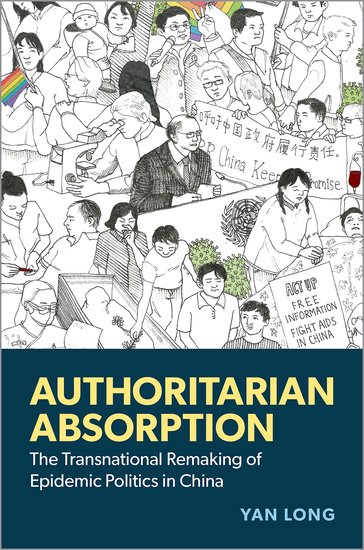
Interviewed by Jian Meng on January 19, 2026
Yan Long is an Associate Professor of Sociology at the University of California, Berkeley. She is a political and organizational sociologist studying the interactions between globalization and authoritarian politics across empirical areas such as public health, civic action, urban development, and digital technology with a geographic focus on China. Her first book, Authoritarian Absorption: The Transnational Remaking of Epidemic Politics in China was published by Oxford University Press in 2024.
Jian Meng: Thank you for taking the time for this interview. To begin with, how did you come to be interested in the core questions addressed in Authoritarian Absorption?
Yan Long: My interests emerged from a striking empirical puzzle when I first entered the field back in 2007. At the beginning, my motivation was just to understand the explosion of numbers in HIV/AIDS NGOs in China. At the time, given all the tightened control and repression, most social movement scholars would say that you want to take much more informal ways of mobilization rather than forming organizations. I was puzzled: Why? Why did they choose such a connected, formalized, organizational way of rebelling against the state?
But then when I started my fieldwork, I was also fascinated by what seemed like a very impossible contradiction—especially nowadays when we think about it. It’s China as the world’s strongest authoritarian regime actually coming to embrace foreigners and a lot of international organizations in HIV. They were embracing civil society participation and grassroots mobilization. In Beijing, I watched foreigners actually being able to sit in very deep, intense policy conversations in health ministries. That’s very much unheard of, because the Chinese government—just like Russia—is very guarded against foreigners. For them to participate, to sit together, and to really work on applying for international funding? That was deeply puzzling.
And then you can see that activists were sitting at the table at United Nations conferences along with ministry officials. I was like, what is going on here? So I wanted to understand that. That was the beginning of a historical puzzle. As I was tracing this process in the next 11 years, things were changing. The Chinese government became really strong.
The relationship, for example, between the Chinese CDC officials and the US CDC officials had completely changed. At the beginning, the Chinese side was worshipping the US side, holding them in high esteem: “We should learn from them.” The US was the golden standard. That was already puzzling. But then you would see a more equal kind of relationship, and China then began to teach other countries in the Global South using global health mandates: “We are the champion of global health, and you guys should learn from us.” Health had really become a major area of international interventions for China to project its global power.
Another core piece of the puzzle crystallized around very specific ironies. For example, China is still nowadays a homophobic state, but gay activists—male gay activists in urban areas—became such a “golden child,” favored by not only the Chinese government but also Westerners like the US Embassy. You would see they became the guests of both camps. One turning point was really in 2013, when Xi Jinping was coming into office. Li Keqiang actually held a meeting on TV, broadcasting for the first time ever a top senior leader shaking hands with gay leaders. It was supposed to be a meeting around HIV intervention, but the majority of the community leaders he met on TV were gay activists—HIV-negative gay activists.
I was like, wow, it’s still a homophobic state. Why would it really embrace gay activists while sidelining farmers, infected farmers, who were supposedly foundational to communist society? And then why did HIV transform from a very invisible, actively erased epidemic in the 1980s and 1990s, to the cornerstone of China’s revamped public health institutions? You must understand every meeting in China was carefully staged. For Li Keqiang to really do that on TV—they also invited UN representatives—it was staged for the whole world to watch. The core of that meeting was signaling its commitment to community participation and signaling that to the whole world.
That really means public health—and a very specific kind of liberal type of public health interventions—became a cornerstone of the authoritarian socialist state. It’s part of this political identity in front of the world like, “We’re really the world champion of liberalism in so many ways.” If we associate certain things with liberalism—like anti-homophobia or community participation—how did they somehow become symbols of China’s rising power? Those are the puzzles I wanted to tackle.
If I can summarize it in a more concise way, it is: if HIV was completely ignored and unseen back in the 1980s and 1990s, if public health was totally marginalized, why does the state suddenly become interested in epidemics? Throughout human history, most governments are either obsessed with certain epidemics or they ignore them. I want to understand how they make this kind of swift alteration between seeing epidemics versus unseen epidemics, and also to understand how they would choose to embrace or reject certain transnational practices.
Importantly, for political sociologists, we need to understand the global expansion of authoritarianism. The paradox here is: if we are seeing this global diffusion of liberalism—which in the Chinese case was very successful—then why did authoritarian control actually expand, as we can see during COVID-19? How do we understand the expansion of authoritarianism and the diffusion of liberalism together? They were actually not, as we imagine, contradictory or conflicting. It’s not the case that if you have more liberalism, you have less authoritarianism. That is what I want to tackle.
Jian: In your book, you describe using a “multi-sited ethnographic approach to historicizing interventions.” Could you tell us what it is and how you combined these two different approaches in your research?
Yan: The research design—the multi-sited ethnography—actually emerged in the 1990s. It was started by George Marcus, and that was my inspiration. Basically, you are talking about tracing people, tracing items, and so on. That was very typical of studying transnationalism. Transnationalism is essentially about interactions across different societies; the governments and the states are the center of internationalism, but for transnationalism, it’s society.
That was my inspiration at the beginning: to really understand the relationships between transnational organizations, the Chinese government, and different community organizations. I was trying to follow people and follow conflict across sites—rural villages affected by blood contamination, urban gay men’s organizations, urban sex workers’ organizations, and different Chinese government agencies, from public health all the way to security and police. I also followed transnational agencies, mostly based in Beijing, and different transnational conferences.
One of the problems with typical ethnographies is that we tend to stay in one place and dig very deep. But then, while you can understand how even one village is embedded in global connections, what you don’t see is the process—the concrete connections. I really wanted to trace across the space to see. On the one hand, you see how transnational connections tie different people and spaces together. The same vocabulary is invoked everywhere; whether in the US or China, activists and officials use identical terms like “knowledge production,” “human rights,” or “activism.” You see that kind of global connectivity.
However, traveling across these spaces also shows how far apart the different worlds are. I remember finishing my ethnography in a rural area and then going back to Beijing to interview a representative of a foreign foundation. The contrast in just one day was huge. We were at lunch in Beijing eating noodle soup that cost about $20, which at the time could sustain someone in a rural area for two days. It wasn’t just the money, but the interaction, the norms, and who I was. After that lunch, I just started bawling. You see this disjuncture where people live completely different lives. In Beijing, when they talk about life and death it is one thing, but it is completely different when you sit with somebody by their deathbed in a village.
Multi-sited ethnography really helps to understand these parallel worlds. To travel from Beijing to the US was just a flight, but for me to go from a village in Henan to Beijing, I had to take multiple forms of transportation—trains, bikes, and walking. It literally took longer. In globalization, you have connection but also disjuncture. Understanding that embodied experience is critical because it’s no longer an abstraction; it has materialized. As an ethnographer, I had to adapt my outfit and my demeanor; my interactions with a farmer are completely different compared to a gay leader in Shanghai. Even for CDC officials, being in Beijing versus being in Henan, that’s also drastically different.
That kind of ethnography provides much more depth, but the problem is it can be a snapshot. A typical way of studying international relations is to understand a snapshot of interventions: foreign organizations come, things happen, and that’s it. Then history becomes just a background. In this book, I tried to trace the process of how interventions started to unfold to understand the unintended consequences that no one—neither the state, the organizations, nor the activists—could control.
The irony here is that the Chinese government became the biggest winner of this process. It’s not because it was the smartest strategist, but because of a lot of unintended dynamics between different actors. International organizations were trying their best to do good and “teach” China, and activists were trying to fight for survival, but who wins or loses isn’t necessarily decided from the beginning. US international development agencies actually did wonders in strengthening China’s epidemic response over two decades. That historical process is important to know because there is a huge contribution there. The outcome might not be what you are anticipated unless you trace it.
Finally, there was a practical reason for this design: studying HIV interventions in China was extremely sensitive. I was constantly harassed, stalked, and I was even detained once. Practically speaking, it was very difficult for me to just stay in one place. I was literally running from one site to another to keep the research going—especially in rural areas, where it is difficult to stay for a long time without implicating my research subjects.
Jian: How did SARS, as a historical event, influence the narrative presented in your book? In the Chapter 6, you mentioned the SARS, but provided few pages on that. I know another scholar, like Katherine Mason, her whole book Infectious Change mainly focused on the CDC during the time of SARS. How do you consider the impact brought by SARS?
Yan: I actually would argue: SARS in my book was not a turning point in itself, but it was a revealing interruption. As I mentioned earlier, throughout the 1980s and 1990s, China pretty much ignored public health, and the old Maoist Public Health system collapsed. China wasn’t interested in building a modern epidemic response system, so infectious disease was just marginalized completely.
In many ways, SARS became a moment that exposed how fragile China’s epidemic governance was already at the time. It revealed the possibility that international pressure actually could intensify. SARS drew that kind of attention not out of the blue, but because foreign governments and organizations had already been trying to pressure the Chinese government on HIV for a couple of years already. The problem was that China was not willing to make concessions, and foreign organizations were not strong enough to push the pressure in. In that battle, SARS happened and it really just exposed the whole epidemic response system. In that way, it was a very important event. But it was not the event itself that had produced all the results.
Mind you, the literature typically shows us that authoritarian states are very good at making window-dressing gestures after international interventions—after all, the naming, blaming, and shaming. That would have been the case with SARS without HIV. Because guess what? Political pressure and international attention eventually go away. What really matters in terms of AIDS is that HIV/AIDS was the first infectious disease put on the global political landscape around the turn of 2000. It was the only epidemic that had received not only political attention but also a huge amount of funding and institutional support because of UNAIDS and other organizations.
Regarding the institutional building process: HIV had a completely different status than SARS per se. In many ways, SARS produced the window of opportunity for HIV funding and pressure to come in. But exactly because of the institutional building around HIV, foreign organizations could actually sustain that pressure by providing money, specific organizational rules, and various policy designs. That’s why rapid organizational expansion took place around HIV, not SARS.
Yes, SARS is important; it created political urgency and global attention. But it was HIV, through very sustained technocratic and transnational engagement, that slowly rebuilt China’s epidemic infrastructure and modernized its responses. In that way, there is a very long post-SARS, but HIV-centered institutional formation. That’s also an irony: HIV still has high mortality aside from COVID, yet its transmission is so low—it is a low-prevalence disease. Why did the state spend so much money on it? It is because HIV enjoyed such a global status. You can’t really compare that with SARS.
Jian: In Chapter 8, you discuss the 2013 departure of the Global Fund as an important backdrop for the Chinese government to increase investment in HIV prevention. Could you tell us the global dynamics or domestic political shifts behind this withdrawal of Global funding?
Yan: The simple answer is that this is really the typical story of the rise of China. International organizations no longer consider China a low-income country; it has graduated towards being a middle-income country. That’s the official reason, but there are others. Global health is a very typical example of international development. The typical funding model that started after the mid-1990s is that when international organizations or foreign governments provide funding, the idea is just to start the institutional building process. The domestic government would then start contributing funding, with the goal being that international funding eventually withdraws and the national government takes over.
That’s always the model. However, many countries cannot graduate from that model and forge a dependence on foreign money. Before the Trump administration, foreign funding actually accounted for almost 50% of all the money dedicated to HIV in low-income and middle-income countries. It took a very long time, and even until very recently, many countries in the Global South still rely heavily on foreign money. But HIV also sustained many countries’ public health infrastructure. China is actually a fascinating example of success in this regard.
Throughout the period before 2013, foreign funding accounted for between 30% to up to 60-70% of the funding dedicated to AIDS in China. It was a lifeline. HIV funding was sustaining a lot of other public health functions. But as the foreign funding was there, the Chinese government also drastically increased its own funding for HIV as well as public health. It was very successful. When the funding started to withdraw, the Chinese government stepped in. The central government continued to give more funding and completely took over.
In many ways, it’s a fascinating success story. This is why China has become a champion in the eyes of the World Health Organization. It wasn’t just about “accepting bribery”—China spent over a decade proving itself as a terrific student. It fulfilled the expectation: “Now we are a superpower; not only can we support our own public health, we can also support other countries’ public health.” Even nowadays, people ask if China should step in as the US leaves the global health leadership position. China has its own international development agency now. The US and UK international development agency models heavily affected China, again through HIV. China is now providing funding not just for African countries but also for Southeast Asian countries.
Even before the Global Fund left, China was already one of the most successful countries in getting international funding because it was a “good student,” successfully producing the best numbers to get money. But the irony here—and a story that’s not very clear in the book—is the decline of the “golden days” of international collaboration between China and the US in public health. This collaboration started to decline during Obama’s second term and was shut down during Trump’s first term. When COVID hit, there was nothing. And nowadays we are in a state of high conflict.
What I documented in the book was the very close-knit collaboration, but that relationship changed after 2013—obviously because of Xi, but also because of the US side as well. In many ways, international funding should leave at some point to allow for local ownership of the system. In that way, China has completely achieved that. The CDC model, everything.
Jian: What are you working on next?
Yan: During COVID I started my second book about epidemics and digital technology, studying COVID in China. It is still a transnational story, but it’s tentatively called Digital Chaos: The Bureaucratic Labors of the COVID-19 Smart City and Its Aftermath. Basically, it looks at authoritarian digitalization during the pandemic and the development that followed. Epidemic governance was a huge part of how authoritarian power and digitalization expanded. That’s a major theme. I wanted to challenge the popular depiction of authoritarian digitalization as an automated, seamless apparatus of control—the cameras, the dashboards, the algorithms.
I want to place that in a long historical process of smart city building in China, which was actually a global idea. Digitalization during COVID was only one episode of it. I want to demonstrate that China’s smart city expansion since the epidemic is a fragmented, labor-intensive, and fragile enterprise, enabled and constrained by existing bureaucratic dynamics. It’s still a state bureaucratic story with a long historical perspective.
Ultimately, it is still about epidemic control, but in a very different direction. My first book argued how HIV molded the characteristics of this epidemic response system, and I want to see how some of those features persisted during COVID-19. For example, the obsession with testing. The US model of epidemic control is drug-centered; it’s more about treatment than prevention. China came up with a different model: prevention through testing. That was experimented with and consolidated during the HIV era, then expanded during the COVID model. I remember a gay community leader in an interview said, “In the past the government only drew our blood; nowadays it is testing everybody.”
That surveillance power persisted. Digitalization is a different feature—the smart city history and the epidemic control history came together to create a very bizarre kind of monster. The number of tests has been praised and projected as a sign of modernization: “China is a superpower; we can do one billion tests per day.” That obsession with numbers is about the projection of state power and global status. All of that imagination was made possible and learned during the HIV era. International society values this kind of quantitative measurement, and you can do it fast. That is the historical precondition of what happened, and I want to continue tracing that.
Jian: It is very interesting. I am looking forward to reading your next book!


Leave a Reply